

LCA & material health results & interpretation StoneLite®
Evaluation programs
The Health Product Declaration®
The HPD Open Standard provides a consistent, and transparent format to accurately disclose the material contents and associated hazard classifications for a building product.
How it works
Material ingredients are screened and categorized according to the hazards that international governmental bodies and toxicology experts have associated with them, based on two listings:
- Authoritative lists maintained or recognized by government bodies
- Screening lists, which include chemicals that government bodies determined need further scrutiny, as well as chemical lists not recognized by any government body.
Assessment scope and results
Health Product Declaration®
StoneLite® Stone Panel
Inventory threshold: 1,000 ppm
Full disclosure known hazards: Yes
Based on the selected content inventory threshold:
- Characterized
- Screened
- Identified
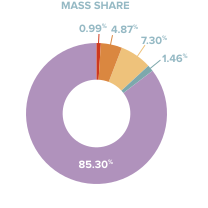
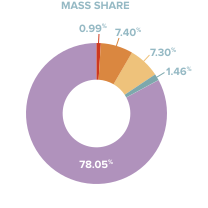
GreenScreen® List Translator Scores
- List Translator Likely Benchmark 1 / Benchmark 1An LT-1 chemical score is based on lists that identify it as a Chemical of High Concern.
- List Translator Possible Benchmark 1An LT-P1 chemical score translates to Possible BM1 and reflects the presence of the chemical on Screening A or B lists and some uncertainty about the classification for key endpoints. Further research is needed on the flagged endpoint to determine if the chemical is indeed a GreenScreen Benchmark 1.
- List Translator Benchmark UnknownAn LT-U chemical score indicates that there is insufficient information to apply the GreenScreen Benchmark Scoring algorithm to the chemical. That can be a good sign. Typically, only hazardous chemicals are found on hazard lists. However, lack of presence on hazard lists can also mean that the chemical has not been well tested. A full GreenScreen assessment will need to be performed to determine if a chemical is a Benchmark 2, 3 or 4.
- Benchmark 2Prefer-safer chemical.
- Benchmark 3Prefer-safer chemical.
- Benchmark 4Prefer-safer chemical.
- No GS data availableNo data available on List Translator lists.
Total VOC Content
Total Volatile Organic Compound (VOC) content for liquid/wet applied products. VOCs get released into the air as the wet applied products dry. VOCs can cause acute symptoms, including headaches and dizziness.VOC Content data is not applicable for this product category.
StoneLite® Porcelain Panel
Inventory threshold: 1,000 ppm
Full disclosure known hazards: Yes
Based on the selected content inventory threshold:
- Characterized
- Screened
- Identified
Total VOC Content
Total Volatile Organic Compound (VOC) content for liquid/wet applied products. VOCs get released into the air as the wet applied products dry. VOCs can cause acute symptoms, including headaches and dizziness.VOC Content data is not applicable for this product category.
What's in this product and why
Once the StoneLite® panels (stone and porcelain) are manufactured and installed, minimal to no exposure is expected during the normal, daily use of the product. Many of the listed hazards are only present during the manufacturing process.
Natural stone is a geologically derived material that constitutes a significant portion of stone panels. Under HPDC's special conditions policy, hazard screening is not applicable to natural stone, as it is considered to have inherently minimal human health impacts in its finished form. Being a naturally occurring material, it does not undergo significant chemical transformations during processing, and any trace elements present are typically bound within its mineral structure, limiting potential exposure risks.
In the case of porcelain panels, the porcelain mass also constitutes a significant portion of the material composition. While frits used in porcelain may exhibit human health hazards during screening, they undergo a high-temperature vitrification process that renders them insoluble and chemically stable. In the final product, any hazardous raw materials are rendered inert, minimizing human health risks during use. Additionally, porcelain’s low porosity and resistance to degradation further reduce the likelihood of any chemical release over time.
In the composition of both types of StoneLite® panels, potential chemical exposure hazards are primarily associated with the manufacturing stage. Certain ingredients in resins, epoxies, and hardeners may present health warnings in their raw form. However, once these materials are fully cured and the panels are installed, they undergo chemical changes that stabilize them. As a result, under normal use conditions, the finished product is not expected to pose health hazards to customers.
How we're making it healthier
In the case of porcelain panels, Coldspring uses porcelain with unleaded frits, eliminating lead and heavy metals that pose health risks. This reduces worker exposure and prevents harmful leaching, making the final product safer for consumers. By choosing unleaded frits, Coldspring ensures a healthier product with lower human health risks, both during production and throughout its use.
The epoxies and bonding agents used in the panels are free from isocyanates, reducing health risks associated with these chemicals. Isocyanates can trigger allergic reactions and respiratory issues. By opting for safer formulations, Coldspring protect workers during production and minimize harmful off-gassing, improving indoor air quality in spaces where the products are installed.
Coldspring opts for non-toxic adhesives and binders whenever possible. This choice reduces the use of volatile organic compounds (VOCs) that can degrade indoor air quality and pose long-term health risks. It enhances safety in manufacturing environments and helps create healthier living spaces by minimizing exposure to harmful chemicals, ensuring the final products are safer for end users.
See how we make it greenerReferences
Health Product Declaration®
StoneLite® Stone Panel
StoneLite® Porcelain Panel
Health Product Declaration Open Standard v2.3
The standard provides guidance to accurately disclose the material contents of a building product using a standard, consistent, and transparent format.
 SM Transparency Report (EPD) ™ + Material Health Overview ™
- VERIFICATION LCA
- 3rd-party reviewed
- Transparency Report (EPD)
- 3rd-party verified
Validity: 02/20/2025 – 02/19/2030
SM-SPI – 20250220 – 001
- Material HealthMaterial
evaluation - Self-declared
This environmental product declaration (EPD) was externally verified, according to ISO 21930:2017, ISO 14025:2006, UL Part A, and UL Part B: Cladding Product Systems by Jack Geibig, President, Ecoform.
Ecoform, LLC
11903 Black Road,
Knoxville, TN 37932
www.ecoform.com
(865) 850-1883

SUMMARY
Reference PCR
UL Part B: Cladding Product Systems
Regions; system boundaries
North America; Cradle to grave
Functional unit; reference service life
1 m² of installed panels; 75 years
LCIA methodology: TRACI 2.1
LCA software; LCI database
SimaPro Developer 9.6; ecoinvent v3.10, US-EI 2.2, Industry data 2.0
Public LCA
LCA of StoneLite® Panels
In accordance with ISO 14044 and the reference PCR, this life cycle assessment was conducted by Sustainable Minds and reviewed by Jack Geibig, President, Ecoform.
© 2026 | The SM Transparency Report [EPD]™ Program is operated by Sustainable Minds® (www.sustainableminds.com) | Privacy policy
Coldspring
17482 Granite West Road
Cold Spring, MN 56320
(800) 328-5040
coldspringusa.com