

LCA results & interpretation StoneLite®
Scope and summary
- Cradle to gate
- Cradle to gate with options
- Cradle to grave
Application
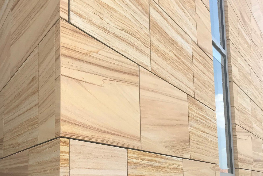
Stone cladding is applied to a building’s exterior to separate it from the natural environment and provide an outer layer to the building. It not only provides protection from the weather elements but also a durable, aesthetically pleasing building appearance. StoneLite® limestone panels are crafted by bonding a thin layer of limestone to a durable aluminum honeycomb core. The stone veneer maintains the authentic appearance and texture of solid stone, while the aluminum honeycomb core offers a high strength-to-weight ratio, enabling the panel to absorb and evenly distribute impact forces. These features make StoneLite® panels a superior choice for both interior and exterior applications where aesthetics, strength, and efficiency are essential.
Functional unit
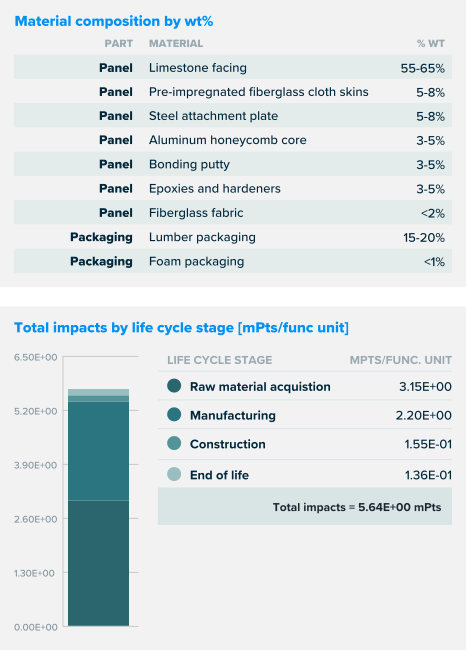
One square meter of installed StoneLite® limestone panels over the building's estimated service life of 75 years. The installed panels, including accessories and other materials, weigh 19.5 kg and have a reference service life of 75 years when installed per the manufacturer's instructions.
Default installation, packaging, and disposal scenarios
StoneLite® panels are cut to size based on customer-provided field measurements so that at the installation site, minimal cuts are required. As confirmed by an installer, approximately 1% of panels are disposed (23.95% landfilled, 1.67% incinerated, and the remainder recycled). 0.62 kg of masonry connectors are needed per functional unit. After installation is complete, lumber and foam packaging (67.16% landfilled, 15.70% incinerated, and the remainder recycled) and plastic packaging (69.44% landfilled, 16.93% incinerated, and the remainder recycled) are transported 100km via truck to the disposal site.
After installation, the panels are not expected to require cleaning, repair, or other activities over their 75-year service life. At the end of life, the panels are manually removed and transported 100km via truck to final disposal (74.4% recycled, 24.0% landfilled, 1.7% incinerated).
What’s causing the greatest impacts
All life cycle stages
For StoneLite® limestone panels, the production stage (A1-A3) dominates the life cycle impacts, which accounts for over ~88% of the total environmental impacts across all impact categories. Raw material acquisition and preprocessing, transportation of stone to the facility, and electricity used during manufacturing are the primary contributors in that stage. The impacts from distribution to installation sites, installation and packaging waste, and disposal at the end of life account for the remainder of impacts.
Raw material acquisition
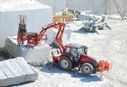
Raw material extraction and upstream processing (A1) has the most substantial impact on five impact categories: smog formation, carcinogenics, non-carcinogenics, respiratory effects, and ecotoxicity. These impacts mainly arise from limestone quarrying and the upstream production of honeycomb cores, pre-impregnated fiberglass cloth skins materials, and attachment plates.
Impacts during transportation (A2) stem from the use of trucks to deliver raw materials to the manufacturing site, with the quarried limestone slabs contributing the most.
Manufacturing
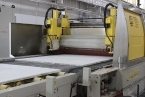
The manufacturing stage (A3) is the largest contributor in four key impact categories: global warming, acidification, eutrophication, and fossil fuel depletion. The primary drivers of these impacts are the consumption of electricity and propane for various manufacturing operations within the production facility.
Construction and use
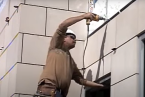
The distribution (A4) of panels to the installation site and activities during installation (A5) contribute about equally to the construction and use (B) phases. Transportation of the panels via truck is most impactful on ozone depletion, and the disposal of packaging and installation waste is more impactful on the global warming, smog, and non-carcinogenics impact categories.
Since the panels are expected to last the life of the building without any additional activities such as maintenance, replacement, or repair, there were no impacts in the use phase.
End of life
The transportation to disposal (C2) via truck dominates end-of-life impacts for most impact categories. Final product disposal (C4) contributes more to the eutrophication and carcinogenics impact categories in this phase.
Embodied carbon
Embodied carbon can be defined as the cradle-to-gate (A1-A3) global warming potential impacts. The total embodied carbon per functional unit of StoneLite® limestone panels is 1.16E+02 kg CO2-eq per functional unit.
Manufacturing data
Stone quarrying data was extracted from Natural Stone Institute’s industry-wide stone cladding LCA published in November 2022. Coldspring fabrication data covers a reporting period of January 2021 – December 2023 from the Marble Falls, TX manufacturing facility.
How we're making it greener
Coldspring is focused on designing solutions for sustainable cladding. From exterior hardscape and cladding to interior design elements, natural stone provides quality and durability that other materials cannot match.
At Coldspring, we offer end-to-end solutions and the highest-quality stone, giving you peace of mind that the finished product will stay intact and looking great far into the future. By using naturally occurring materials in our cladding solutions, we minimize the amount of additional processing needed to create an environment-conscious product
LCA results
| Life cycle stage | Raw material acquisition | Manufacturing | Construction | Use | End of life |
|
Information modules: Stages B1-B7, C1, and C3 though included, have no associated activities. |
(X) A1 Raw material supply | (X) A3 Manufacturing | (X) A4 Distribution | (X) B1 Use | (X) C1 Deconstruction |
| (X) A2 Upstream transportation | (X) A5 Installation | (X) B2 Maintenance | (X) C2 Waste Transportation | ||
| (X) B3 Repair | (X) C3 Waste processing | ||||
| (X) B4 Replacement | (X) C4 Disposal | ||||
| (X) B5 Refurbishment | |||||
| (X) B6 Operational energy use | |||||
| (X) B7 Operational water use | |||||
 |
 |
 |
 |
 |
SM Single Score
Learn about SM Single Score results| Impacts per 1 square meter of installed StoneLite® limestone panels | 3.15E+00 mPts | 2.20E+00 mPts | 1.55E-01 mPts | 0 mPts | 1.36E-01 mPts |
| Materials or processes contributing >20% to total impacts in each life cycle stage | Manufacturing of purchased components and upstream transport of limestone. | Electricity and propane consumption during manufacturing. | Truck transportation to building site. | N/A | Waste transportation to disposal. |
TRACI v2.1 results per functional unit
| Life cycle stage | Raw material acquisition | Manufacturing | Construction | Use | End of life |
Ecological damage
Human health damage
Additional environmental information
| Impact category | Unit | |||||
| Fossil fuel depletion | MJ surplus Mega Joule, lower heating value Fossil fuel depletion is the surplus energy to extract minerals and fossil fuels. |
8.62E+01 | 9.03E+01 | 5.26E+00 | 0 | 4.62E+00 |
| Ecotoxicity | CTUe Comparative Toxic Units of Ecotoxicity Ecotoxicity causes negative impacts to ecological receptors and, indirectly, to human receptors through the impacts to the ecosystem. |
85.6% | 11.4% | 2.1% | 0% | 0.9% |
References
LCA Background Report
LCA of StoneLite® panels (public version), Coldspring 2025. Developed using the TRACI v2.1, CML, and Cumulative Energy Demand (LHV) impact assessment methodologies, SimaPro Developer 9.6 modeling software, Ecoinvent v3.10, US-EI 2.2, and Industry Data 2.0 databases.
ISO 14025, “Sustainability in buildings and civil engineering works -- Core rules for environmental product declarations of construction products and services”
ISO 21930:2017, "Sustainability in Building Construction — Environmental Declaration of Building Products" serves as the core PCR.
UL Part A: Life Cycle Assessment Calculation Rules and Report Requirements v4.0
March, 2022. PCR review conducted by Lindita Bushi, PhD, Chair (Athena Sustainable Materials Institute), [email protected]; Hugues Imbeault-Tétreault (Group AGECO); and Jack Geibig (Ecoform).
UL Part B: Cladding Product Systems EPD Requirements, v2.0
April, 2021. PCR review conducted by Jim Mellentine (Thrive ESG); Christoph White, Ph.D. (NIST); and Philip S. Mose, P.E. (MA) (Simpson Gumpertz & Heger).
UL Environment General Program Instructions v2.5, March 2021 (available upon request)
Download PDF SM Transparency Report/ EPD
SM Transparency Reports (TR) are ISO 14025 Type III environmental declarations (EPD) that enable purchasers and users to compare the potential environmental performance of products on a life cycle basis. Environmental declarations from different programs (ISO 14025) may not be comparable. Comparison of the environmental performance of Cladding Product Systems using EPD information shall be based on the product’s use and impacts at the building level, and therefore EPDs may not be used for comparability purposes when not considering the building energy use phase. Full conformance with the PCR for stone cladding allows EPD comparability only when all stages of a life cycle have been considered, when they comply with all referenced standards, use the same sub-category PCR, and use equivalent scenarios with respect to construction works. However, variations and deviations are possible. Example of variations: Different LCA software and background LCI datasets may lead to differences results for upstream or downstream of the life cycle stages declared.
 SM Transparency Report (EPD)