

LCA results & interpretation PROFLO® Single Handle Lavatory Faucet
Scope and summary
- Cradle to gate
- Cradle to gate with options
- Cradle to grave
Functional unit
One lavatory faucet in an average commercial environment over the estimated service life of the building. The expected service life (ESL) of a building is 75 years, and all use stage activity and impacts are accounted for in that full ESL period. The reference service life (RSL) of the faucet is 10 years, and one faucet weighs a total of 1.57kg.
Manufacturing data
Manufacturing data has been collected at the manufacturing facility in Vietnam for the data reporting period of 2023.
Maintenance
The cleaning of the faucet involves cleaning it 260 days per year using 10mL of a 1% sodium lauryl sulfate (SLS) solution per cleaning event for 75 years, which is the building estimated service life. The use of 10 mL/clean over 260 days per year for 75 years gives a total of 195L of solution.
Replacement
After the end of the faucet's reference service life, it is assumed to be fully replaced. An additional 6.5 replacements are included over the building's ESL of 75 years. No auxiliary materials, electricity, or other hardware components are consumed during the replacement.
What’s causing the greatest impacts
All life cycle stages
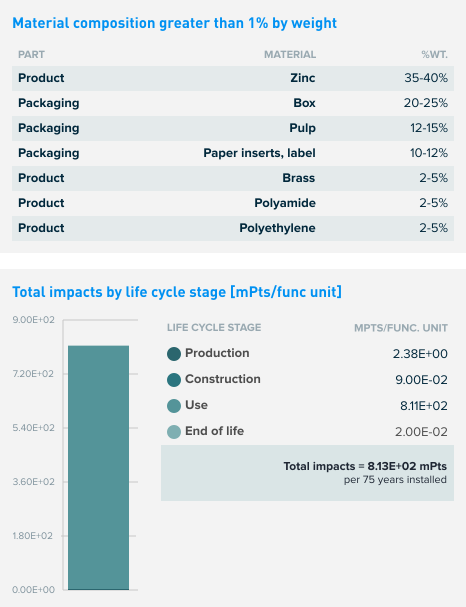
Environmental performance is driven primarily by the use stage. The energy consumption during the use phase contributes to ~99% of potential CO2-equivalent emissions across the life cycle of the faucets, with the potential CO2-equivalent emissions from the 1.2gpm faucet about 2.4 times higher than those for the 0.5gpm faucet.
Production and installation
The production and installation stages themselves account for <1% of the impacts in most categories. The production stage accounts for ~1.4% of carcinogenics, primarily due to the processes required to manufacture the faucet.
Use
The use stage itself contributes to ~90% of the total impacts. Within the use stage, the operational energy use from heating the faucet water dominates the results for six impact categories, followed by operational water use.
Compared to the other stages, product replacements and maintenance also show relatively higher impacts across most impact categories. Maintenance impacts are driven by the use of the cleaning solution, and replacement impacts stem from having to replace the faucet every 10 years.
End of life
The end-of-life stage accounts for a relatively low portion of the results for all impact categories, at <0.1% in all categories. This is driven by the landfilling of the products at the end of their useful life.
Operational energy and water use
The energy used to heat water consumed by the faucet is included. Water heating energy is assumed to be a blend of 67% natural gas and 33% electricity, using factors of 0.1765 kWh of electricity per gallon of water and 6.571 liters of natural gas per liter of water.
The amount of water used by the faucet depends on its flow rate. The 1.2gpm faucet is assumed to be used for 10 seconds per use, with 90 uses/day and 260days/year over 75 years, resulting in 351,000 gallons of water over its lifetime. An electricity factor of 0.000961 kWh per liter of water is used to represent energy for upstream municipal water collection, treatment, supply, and downstream management.
How we're making it greener
Ferguson has established an EHS system that complies with regulations and serves to educate its team, attaching importance to environmental protection, energy savings and waste reduction, health and safety, and continuous improvement. The have implemented:
- Routine inspection and monitoring of environmental protection facilities in the production process
- Environmental monitoring plans
- Waste monitoring
- Improvements to the level of accuracy across all operations
LCA results
| Life cycle stage | Production | Construction | USE | End of Life |
|
Information modules: |
(X) A1 Raw materials | (X) A4 Transportation/ Delivery | (X) B1 Use | (X) C1 Deconstruction/ Demolition |
| (X) A2 Transportation | (X) A5 Construction/ Installation | (X) B2 Maintenance | (X) C2 Transportation | |
| (X) A3 Manufacturing | (X) B3 Repair | (X) C3 Waste processing | ||
| (X) B4 Replacement | (X) C4 Disposal | |||
| (X) B5 Refurbishment | ||||
| (X) B6 Operational energy use | ||||
| (X) B7 Operational water use | ||||
 |
 |
 |
 |
SM Single Score [mPts/func unit]
Learn about SM Single Score results| Single Handle Lavatory Faucet PFWSC3007CP (1.2 gpm) | 2.38 mPts | 0.09 mPts | 810.57 mPts | 0.02 mPts |
| Materials or processes contributing >20% to total impacts in each life cycle stage | Forming, machining, surface treatment, and polishing components into the final faucet product. | Transportation of the product to installation site or consumer and disposal of packaging. | Energy used to heat the hot water used by the faucet. | Transport to waste processing and final disposal of the faucet in a landfill. |
TRACI v2.1 results per functional unit - PFWSC3007CP Faucet (1.2 gpm)
| Life cycle stage | Production | Construction | USE | End of Life |
Ecological damage
Human health damage
Additional environmental information
| Impact category | Unit | ||||
| Carcinogenics | CTUh Comparative Toxic Units of Human cancerous toxicity Carcinogens have the potential to form cancers in humans. |
7.80E-07 | 6.50E-09 | 1.23E-04 | 1.79E-09 |
| Non-carcinogenics | CTUh Comparative Toxic Units of Human non-cancerous toxicity Non-Carcinogens have the potential to causes non-cancerous adverse impacts to human health. |
8.88E-06 | 7.95E-08 | 2.42E-03 | 7.73E-09 |
| Ecotoxicity | CTUe Comparative Toxic Units of Ecotoxicity Ecotoxicity causes negative impacts to ecological receptors and, indirectly, to human receptors through the impacts to the ecosystem. |
3.10E+01 | 1.30E+00 | 5.94E+03 | 9.74E-02 |
| Fossil fuel depletion | MJ surplus Mega Joule, lower heating value Fossil fuel depletion is the surplus energy to extract minerals and fossil fuels. |
5.12E+00 | 1.88E+00 | 1.21E+04 | 2.08E-01 |
References
LCA Background Report
LCA background report of Ferguson single handle lavatory faucets & residential two-piece toilets, 2024; SimaPro Analyst 9.5; ecoinvent v3; TRACI 2.1.
ISO 14025, “Sustainability in buildings and civil engineering works -- Core rules for environmental product declarations of construction products and services”
ISO 21930:2017, "Sustainability in Building Construction — Environmental Declaration of Building Products" serves as the core PCR along with Sustainable Minds Part A.
SM Part A: LCA calculation rules and report requirements, version 2023
August, 2023. PCR review conducted by the Sustainable Minds TAB, [email protected].
SM Part B: Commercial/public metered and manual lavatory faucets, v3.0
March, 2024. PCR reviewed for conformance to ISO 14025, ISO 21930:2017, and ACLCA PCR Open Standard v1.0 by Hugues Imbeault-Tétreault, ing., M.Sc.A., Chair (Groupe AGÉCO); Rebe Feraldi, LCACP, CLAR (TranSustainable Enterprises, LLC); Rifat Karim (Sphera)
Download PDF SM Transparency Report/EPD
SM Transparency Reports (TR) are ISO 14025 Type III environmental declarations (EPD) that enable purchasers and users to compare the potential environmental performance of products on a life cycle basis. They are designed to present information transparently to make the limitations of comparability more understandable. Environmental declarations of products that conform to the same PCR and include the same life cycle stages, but are made by different manufacturers, may not sufficiently align to support direct comparisons. They therefore cannot be used as comparative assertions unless the conditions as defined in ISO 14025 Section 6.7.2. ‘Requirements for Comparability’ are satisfied. In order to support comparative assertions, this EPD meets all comparability requirements stated in ISO 14025:2006. However, differences in certain assumptions, data quality, and variability between LCA data sets may still exist. Any EPD comparison must be carried out at the building level per ISO 21930 guidelines, use the same sub-category PCR where applicable, include all relevant information modules, be limited to EPDs applying a functional unit, and be based on equivalent scenarios with respect to the context of construction works. Some LCA impact categories and inventory items are still under development and can have high levels of uncertainty. To promote uniform guidance on the data collection, calculation, and reporting of results, the ACLCA methodology (ACLCA 2019) was used.
 SM Transparency Report (EPD)