

LCA results & interpretation Chinaware CT728CU
Scope and summary
- Cradle to gate
- Cradle to gate with options
- Cradle to grave
Functional unit
One commercial toilet in an average commercial environment. The expected service life (ESL) of a building is 75 years, and all use stage activity and impacts are accounted for in that full ESL period. The reference service life (RSL) of the toilet is 30 years, which is an industry-accepted average lifespan based on the economic lifespan of the product.
Maintenance
Regular cleaning is assumed to use 1.69 fl oz (50mL) of a 1% sodium lauryl sulfate (SLS) solution daily for 75 years, which is building estimated service life. The use of 50mL/day over 260days/year for 75 years gives a total of 975L of solution. Using a density of 1.01kg/L for a 1% SLS solution, 985kg of solution will be needed over the course of 75 years. Therefore, 9.8kg of SLS plus 975kg of water were included in the model.
Replacement
An additional 1.5 products are included as replacements, with all life cycle modules considered, over the building's ESL of 75 years. Electrical and other hardware components, especially related to rubber for watertight connections and moving parts, require replacement earlier than the 30-year RSL.
Manufacturing data
Manufacturing data has been collected and compiled for TOTO India. Data reporting period: 2023.
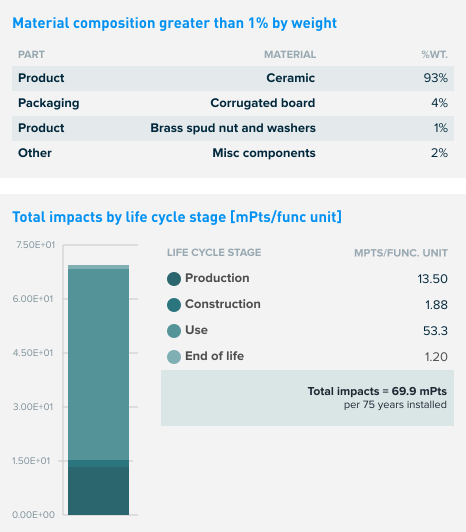
What’s causing the greatest impacts
All life cycle stages
The use stage [B1-B7] dominates the results for all impact categories. The replacements module [B4] is highly dominant in all categories because of the necessity to consider an additional 1.5 products as replacements. All life cycle modules are considered throughout the estimated service life (ESL) of the building, which is 75 years. The production stage [A1-A3] itself is slightly significant but does not dominate in any impact category. Additionally, the processes associated with dismantling the product and final waste treatment during the end-of-life stage do not have a significant impact.
Production stage [A1-A3]
The ceramic parts dominate all impact categories in the production stage except for ozone depletion, non-carcinogenics, and eutrophication. The brass parts together with the injection molding process have dominant contributions to the ozone depletion, non-carcinogenics, and eutrophication impact categories. The remaining parts and processes contribute between 4% and 23% of the overall impacts in the rest of the categories. The entire production stage itself accounts for 22% of the global warming potential impact category.
Construction stage [A4-A5]
Installation of the product dominates impacts in the construction stage. Transportation by truck for delivery to the installation site contributes the most, and this stage contributes to approximately 1% of the total global warming potential impacts throughout the product's life cycle.
Use stage [B1-B7]
Product replacements dominate impacts in the use stage. The use stage itself dominates all impact categories (>75%) due to the consideration of an additional 1.5 products as replacements.
End-of-life stage [C1-C4]
The transportation to landfill dominates impacts in the end-of-life stage. Transportation and the processes for dismantling the product contribute to a relatively low portion of global warming potential (~0.1%) but account for approximately 13% of smog formation.
How we're making it greener
TOTO PeoplePlanetWater™ programs improving environmental performance
- Dual-Max®, E-Max®, Tornado Flush™, 1G®, and EcoPower® reduce water consumption in the use phase
- Energy efficiency programs optimize the firing process
- Modular packing methods increase the fill rate of a trailer, cutting down on the number of trips needed
- 100% of post-industrial ceramic waste is recycled
LCA results
| Life cycle stage | Production | Construction | USE | End of Life |
|
Information modules: |
(X) A1 Raw materials | (X) A4 Transportation/ Delivery | (X) B1 Use | (X) C1 Deconstruction/ Demolition |
| (X) A2 Transportation | (X) A5 Construction/ Installation | (X) B2 Maintenance | (X) C2 Transportation | |
| (X) A3 Manufacturing | (X) B3 Repair | (X) C3 Waste processing | ||
| (X) B4 Replacement | (X) C4 Disposal | |||
| (X) B5 Refurbishment | ||||
| (X) B6 Operational energy use | ||||
| (X) B7 Operational water use | ||||
 |
 |
 |
 |
SM Single Score
Learn about SM Single Score results| Impacts per toilet | 13.5 mPts | 1.88 mPts | 53.3 mPts | 1.20 mPts |
| Materials or processes contributing >20% to total impacts in each life cycle stage | Ceramic parts production together with brass parts and injection molding process. | Transportation of the product to installation site or consumer and disposal of packaging. | Cleaning agent and water used during maintenance and embedded energy used to treat cleaning water. | Transport to waste processing and disposal of material flows transported to a landfill. |
TRACI v2.1 results per functional unit
| Life cycle stage | Production | Construction | USE | End of Life |
Ecological damage
Human health damage
Additional environmental information
| Impact category | Unit | ||||
| Carcinogenics | CTUh Comparative Toxic Units of Human cancerous toxicity Carcinogens have the potential to form cancers in humans. |
3.00E-06 | 1.81E-07 | 1.13E-05 | 2.51E-08 |
| Non-carcinogenics | CTUh Comparative Toxic Units of Human non-cancerous toxicity Non-Carcinogens have the potential to causes non-cancerous adverse impacts to human health. |
2.82E-05 | 1.70E-06 | 1.05E-04 | 2.26E-07 |
| Ecotoxicity | CTUe Comparative Toxic Units of Ecotoxicity Ecotoxicity causes negative impacts to ecological receptors and, indirectly, to human receptors through the impacts to the ecosystem. |
1.08E+02 | 3.23E+01 | 4.25E+02 | 4.28E+00 |
| Fossil fuel depletion | MJ surplus Mega Joule, lower heating value Fossil fuel depletion is the surplus energy to extract minerals and fossil fuels. |
1.29E+02 | 2.34E+01 | 7.01E+02 | 3.54E+00 |
References
LCA Background Report
LCA background report of TOTO sanitary ceramic products, 2024; SimaPro Analyst 9.5; ecoinvent v3, Industry data 2.0, and US-EI 2.2 databases; TRACI 2.1.
ISO 14025, “Sustainability in buildings and civil engineering works -- Core rules for environmental product declarations of construction products and services”
ISO 21930:2017, "Sustainability in Building Construction — Environmental Declaration of Building Products" serves as the core PCR along with Sustainable Minds Part A.
SM Part A: LCA calculation rules and report requirements, version 2023
August, 2023. PCR review conducted by the Sustainable Minds TAB, [email protected].
SM Part B: Commercial toilets, v3.0
March, 2024. PCR review conducted by Jack Geibig, Chair (Ecoform) [email protected]; Hugues Imbeault-Tétreault, ing., M.Sc.A. (Groupe AGÉCO); Rebe Feraldi, LCACP, CLAR (Pacific Northwest National Laboratory).
Download PDF SM Transparency Report/EPD
SM Transparency Reports (TR) are ISO 14025 Type III environmental declarations (EPD) that enable purchasers and users to compare the potential environmental performance of products on a life cycle basis. They are designed to present information transparently to make the limitations of comparability more understandable. Environmental declarations of products that conform to the same PCR and include the same life cycle stages, but are made by different manufacturers, may not sufficiently align to support direct comparisons. They therefore cannot be used as comparative assertions unless the conditions as defined in ISO 14025 Section 6.7.2. ‘Requirements for Comparability’ are satisfied. In order to support comparative assertions, this EPD meets all comparability requirements stated in ISO 14025:2006. However, differences in certain assumptions, data quality, and variability between LCA data sets may still exist. Any EPD comparison must be carried out at the building level per ISO 21930 guidelines, use the same sub-category PCR where applicable, include all relevant information modules, be limited to EPDs applying a functional unit, and be based on equivalent scenarios with respect to the context of construction works. Some LCA impact categories and inventory items are still under development and can have high levels of uncertainty. To promote uniform guidance on the data collection, calculation, and reporting of results, the ACLCA methodology (ACLCA 2019) was used.
 SM Transparency Report (EPD)