

LCA results & interpretation AIR-SHIELD™
Scope and summary
- Cradle to gate
- Cradle to gate with options
- Cradle to grave
Application
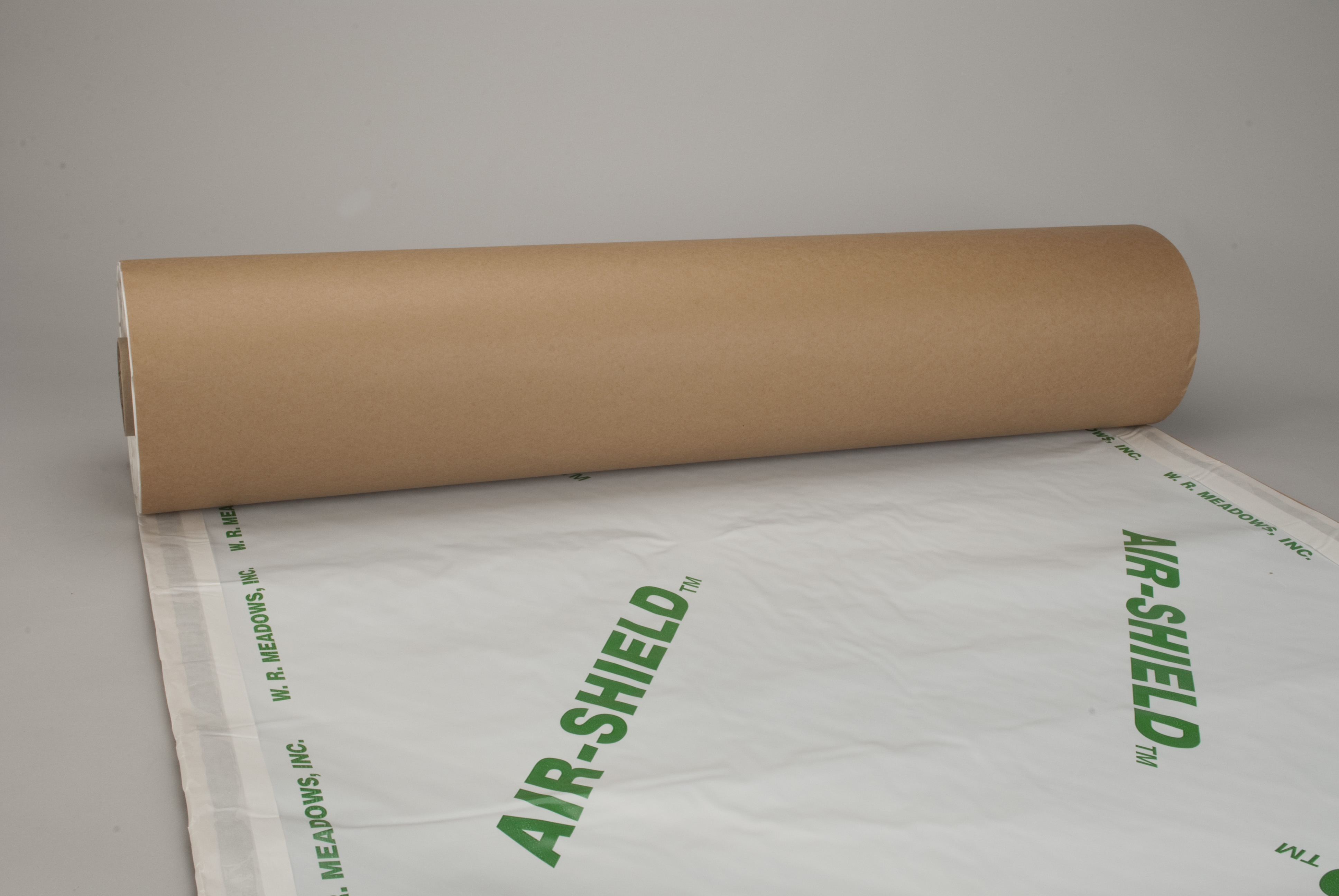
AIR-SHIELD LOW TEMP is a sheet-applied air barrier designed for cold weather applications, adhering at temperatures as low as 20°F (-7°C). It features a 40mil membrane made from cross-laminated polyethylene and modified asphalt, meeting the Massachusetts Commercial Energy Code and ABAA Section 07261.
Declared unit
Coverage rate (kg/m2) = 1.328 kg/m2
Manufacturing data
Reporting period: January 2023 – December 2023
Location: Hampshire, IL
Sensitivity analysis
Sensitivity analyses were performed to check the robustness of the results where the highest potential environmental impacts are occurring. Since there were two raw materials which contributed the most to total impacts across air and vapor barrier products evaluated, sensitivity analyses were conducted on their usage to assess the impact of decreasing their presence in those products.
Global warming potential was evaluated for sensitivity since W. R. Meadows is interested in the potential CO2-equivalent emissions of its products. Decreasing the amount of styrene butadiene copolymer by 10% could reduce the total GWP by 2.9%, and decreasing the amount of LLDPE resin could lower the total GWP by 13.8%. This shows that global warming potential is sensitive to the amount of LLDPE resin present in the products.
What’s causing the greatest impacts
All life cycle stages
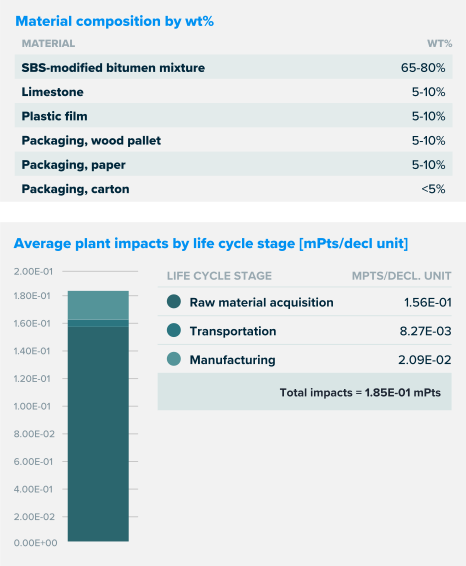
The raw material acquisition stage dominates the results, accounting for over 70% of the total impacts for nine out of ten TRACI 2.1 impact categories, followed by the manufacturing stage. For global warming, eutrophication, carcinogenics, and non-carcinogens, manufacturing accounted for second-highest contributor and over 20% of the total results. Among the raw materials, the polyethylene resin was the largest contributor to the total results.
Raw material acquisition
The raw material acquisition (A1) stage has the most significant contribution to most impact categories, primarily due to the polyethylene resin. The polyethylene resin also contributes the highest percentage to the material composition.
Transportation
The transportation (A2) of raw materials is the least impactful contributor to the total results. Materials are sourced from within America and transported via semi-truck to the manufacturing facility.
Manufacturing
Manufacturing (A3) is the second highest contributor to most impact categories. The primary driver of environmental impacts within the manufacturing stage is the energy required to produce the panels. However, impacts from the manufacturing stage dominate the results for global warming, ozone depletion, and fossil fuel depletion, stemming primarily from the use of electricity and natural gas. Activities in this stage also include final product packaging and manufacturing waste disposal.
Embodied carbon
Embodied carbon can be defined as the cradle-to-gate (A1-A3) global warming potential impacts. The total embodied carbon per declared unit of AIR-SHIELD™ LOW TEMP is 2.32E+00 kg CO2-eq.
How we're making it greener
- W. R. MEADOWS utilizes OEE (Overall Equipment Effectiveness) to optimize manufacturing processes and reduce energy consumption.
- OEE identifies inefficiencies and wasted energy: By monitoring equipment performance, it uncovers downtime, slow speeds, and quality defects.
- Energy-saving improvements through OEE: Meadows has achieved streamlined processes, better scheduling, reduced machine wear, and lower energy costs.
- Reduction in scrap and waste: OEE insights help identify performance issues, reducing defects, delays, and material waste while enhancing product quality.
- Supports sustainability and environmental goals: By lowering energy use and cutting carbon footprints, OEE fosters more sustainable manufacturing practices.
LCA results
| Life cycle stage | A1 Raw material acquisition | A2 Transport | A3 Manufacturing |
|
Information modules:
|
(X) A1 Raw material acquisition | (X) A2 Transport | (X) A3 Manufacturing |
 |
 |
 |
SM Single Score
Learn about SM Single Score results| Impacts per declared unit | 1.56E-01 mPts | 8.27E-03 mPts | 2.09E-02 mPts |
| Materials or processes contributing >20% to total impacts in each life cycle stage | Extraction and preprocessing of polymers, mastic asphalt, and other raw materials. | Truck transportation to manufacturing facility. | Electricity and natural gas consumption during the manufacturing process. |
Life cycle impact results per declared unit
| Life cycle stage | A1 Raw material supply | A2 Transport | A3 Manufacturing |
Ecological damage
Human health damage
Additional environmental information
References
LCA Background Report
LCA of W. R. MEADOWS Water Resistive and Air Barriers, 2025. Developed using the IPCC Fifth Assessment Report (AR5) 100-year time, TRACI v2.1, CML, and Cumulative Energy Demand (LHV) impact assessment methodologies, SimaPro Analyst 9.6 software, and ecoinvent v3.10 and US-EI 2.2 databases.
ISO 14025:2006 Environmental labels and declarations — Type III environmental declarations — Principles and procedures
ISO 21930:2017, Sustainability in buildings and civil engineering works -- Core rules for environmental product declarations of construction products and services
ASTM PCR for Water-Resistive and Air Barriers (UNCPC 54530 and/or CSI MasterFormat DESIGNATIONS 072500, 072600 and 072700); Version 3.0, September 2024. PCR review conducted by Thomas Gloria, PhD (chair, [email protected]); Graham Finch (RDH, Building Science, Inc.) and Paul H. Shipp (USG Corporation).
Download AIR-SHIELD™ LOW TEMP PDF SM Transparency Report [EPD]
SM Transparency Reports (TR) are ISO 14025 Type III environmental declarations (EPD) that enable purchasers and users to compare the potential environmental performance of products on a life cycle basis. Environmental declarations from different programs (ISO 14025) may not be comparable. Comparison of the environmental performance using EPD information shall consider all relevant information modules over the full life cycle of the products within the building. This PCR allows EPD comparability only when the same functional requirements between products are ensured and the requirements of ISO 21930:2017 §5.5 are met. It should be noted that different LCA software and background LCI datasets may lead to differences results for upstream or downstream of the life cycle stages declared. LCIA results are relative expressions and do not predict impacts on category endpoints, the exceeding of thresholds, safety margins or risks. These six impact categories are globally deemed mature enough to be included in Type III environmental declarations. Other categories are being developed and defined and LCA should continue making advances in their development. However, the EPD users shall not use additional measures for comparative purposes. Comparison of the environmental performance of structural and architectural wood products using EPD information shall be based on the product’s use and impacts at the construction works level, and therefore EPDs may not be used for comparability purposes when not considering the construction works energy use phase as instructed under this PCR. Full conformance with the PCR for structural and architectural wood products allows EPD comparability only when all stages of a life cycle have been considered, when they comply with all referenced standards, use the same sub-category Part B PCR, and use equivalent scenarios with respect to construction works. However, variations and deviations are possible. Example of variations: Different LCA software and background LCI datasets may lead to differences results for upstream or downstream of the life cycle stages declared.
 SM Transparency Report (EPD)