

LCA & material health results & interpretation PROFLO® Calhoun 1500 Series Toilet
Evaluation programs
The Health Product Declaration®
The HPD Open Standard provides a consistent, and transparent format to accurately disclose the material contents and associated hazard classifications for a building product.
How it works
Material ingredients are screened and categorized according to the hazards that international governmental bodies and toxicology experts have associated with them, based on two listings:
- Authoritative lists maintained or recognized by government bodies
- Screening lists, which include chemicals that government bodies determined need further scrutiny, as well as chemical lists not recognized by any government body.
Assessment scope and results
Health Product Declaration®
PROFLO® Calhoun 1500 Series Toilet
Inventory threshold: 1000ppm
Full disclosure known hazards: Yes
Based on the selected content inventory threshold:
- Characterized
- Screened
- Identified
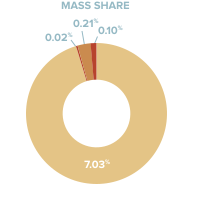
GreenScreen® List Translator Scores
- List Translator Likely Benchmark 1 / Benchmark 1An LT-1 chemical score is based on lists that identify it as a Chemical of High Concern.
- List Translator Possible Benchmark 1An LT-P1 chemical score translates to Possible BM1 and reflects the presence of the chemical on Screening A or B lists and some uncertainty about the classification for key endpoints. Further research is needed on the flagged endpoint to determine if the chemical is indeed a GreenScreen Benchmark 1.
- List Translator Benchmark UnknownAn LT-U chemical score indicates that there is insufficient information to apply the GreenScreen Benchmark Scoring algorithm to the chemical. That can be a good sign. Typically, only hazardous chemicals are found on hazard lists. However, lack of presence on hazard lists can also mean that the chemical has not been well tested. A full GreenScreen assessment will need to be performed to determine if a chemical is a Benchmark 2, 3 or 4.
- Benchmark 2Prefer-safer chemical.
- Benchmark 3Prefer-safer chemical.
- Benchmark 4Prefer-safer chemical.
- No GS data availableNo data available on List Translator lists.
Total VOC Content
Total Volatile Organic Compound (VOC) content for liquid/wet applied products. VOCs get released into the air as the wet applied products dry. VOCs can cause acute symptoms, including headaches and dizziness.VOC Content data is not applicable for this product category.
What's in this product and why
The primary ingredient for this product is ceramic material which contributes to the bulk of toilet tank and toilet bowl. Ceramics is a geological material, meets HPDC special conditions policy, and hazard screening is not applicable. There are some substances used in non-ceramic toilet components that show higher human health hazards as indicated in Pharos chemical and materials library. Some substances also appear on additional listings like Restricted list of Perkins & Will and Cradle to Cradle Products Innovation Institute (C2CPII), but this share is minimal.
Only about 0.3% of the product mass is scored either Benchmark 1 (BM1) or Possible Benchmark 1 (LT-P1). However, the user should not be concerned about interaction with the product. The hazards posed by alloy substances in the flush fittings are generally safe in their alloyed forms and the risk of exposure to harmful levels of these substances from regular use of toilet is extremly low. On the other hand, ingredients of rubber are chemically bound and are stable in the formation of rubber, so do not pose risk to human health.
How we're making it healthier
Rubber rings degrade and can release volatile compounds over time. These are suggested to be replaced every 20 years which minimizes such possibility. Corrosion of metals could also release small amount of metals into the surrounding environment. The metal parts are to be replaced if there is any significant rust or degradation.
See how we make it greenerReferences
Health Product Declaration®
PROFLO® Calhoun 1500 Series Toilet
Health Product Declaration Open Standard - all versions
The standard provides guidance to accurately disclose the material contents of a building product using a standard, consistent, and transparent format.
 SM Transparency Report (EPD) ™ + Material Health Overview ™
- VERIFICATION LCA
- 3rd-party reviewed
- Transparency Report (EPD)
- 3rd-party verified
Validity: 08/13/2024 – 08/12/2029
FER – 20240813 – 002
- Material HealthMaterial
evaluation - Self-declared
This environmental product declaration (EPD) was externally verified by Industrial Ecology Consultants, according to ISO 21930:2017; SM Part A; SM Part B: Residential toilets; and ISO 14025:2006.
Industrial Ecology Consultants
35 Bracebridge Rd
Newton, MA 02459
www.industrial-ecology.com
(617) 553-4929

SUMMARY
Reference PCR
SM Part B: Residential toilets, v3.0
Regions; system boundaries
North America; Cradle-to-grave
Functional unit
One residential toilet in an average residential environment used over the estimated service of the building
LCIA methodology; LCA software; LCI database
TRACI 2.1; SimaPro Analyst 9.5; ecoinvent v3.10 and US-EI 2.2 databases
Public LCA
LCA background report of Ferguson single handle lavatory faucets & residential two-piece toilets
©2026 | The SM Transparency Report™ Program is operated by Sustainable Minds® | Privacy policy