
LCA results & interpretation MFI® System
Scope and summary
- Cradle to gate
- Cradle to gate with options
- Cradle to grave
Application
The MFI® system is a high-performance clip-and-rail cladding attachment solution engineered for thermal efficiency and design flexibility with mineral fiber or spray foam insulation. It features a continuous rail mounted to intermittent, thermally isolated ThermaBrackets®, which can be installed in either vertical or horizontal orientations. The system integrates the ThermaStop® thermal isolation assembly to significantly reduce thermal bridging and improve overall energy performance. Two versions are available: the static S-Series with a fixed S-Rail to ThermaBracket-S connection, and the dynamic D-Series with an adjustable D-Rail to ThermaBracket-D connection. Both are offered in 16- or 18-gauge steel, with various depths and lengths to meet diverse project needs. For this study, the selected representative system is the 16-gauge S-Series rail with a 2-inch ThermaBracket-S.
Declared unit
The declared unit is 0.6096 m (24 linear inches) of cladding support system consisting of a single clip unit, if applicable, and 24 inches length of metal rails with the clip spaced at one per 24 inches. For MFI® system, clip is applicable. The exterior cavity depth is sufficient to accommodate 101.6 mm (4 inches) of insulation plus depth of support components outboard of the insulation layer to which the cladding is attached. Fasteners are excluded.
Mass per declared unit: 0.742 kg
Manufacturing data
Reporting period: January 2024 – December 2024
Location: Deer Park, WA
What’s causing the greatest impacts
All life cycle stages
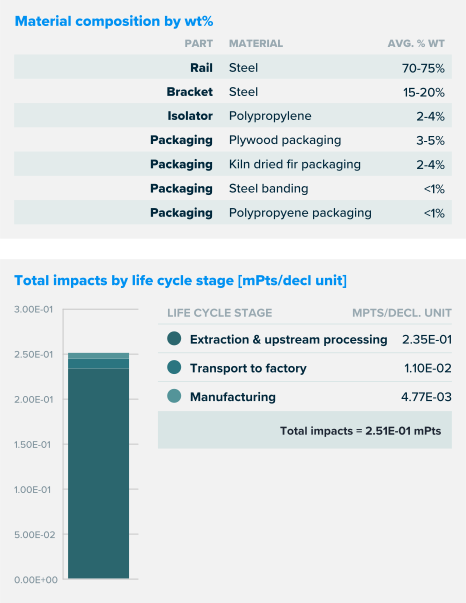
The cradle-to-gate life cycle impacts of the product are primarily driven by the material extraction and upstream processing module (A1), which accounts for over 83% of the total impacts across nearly all environmental impact categories. In the case of ozone depletion and smog, where A1's contribution is relatively lower, it still remains the largest contributor, responsible for approximately 70% of the impacts among the A1 to A3 modules. Transportation (A2) is generally the second-highest contributor, although its impacts are significantly lower than those of A1. The manufacturing module (A3) typically contributes less than A2 but exceeds it in ozone depletion, carcinogenics, and non-carcinogenics. Overall, both A2 and A3 have relatively minor contributions compared to the dominant influence of A1.
Extraction and upstream processing
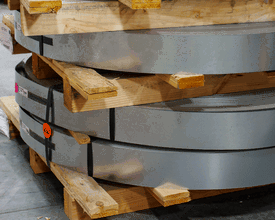
The A1 module dominates the results across all impact categories and includes activities related to raw material extraction and upstream production or preprocessing. It is the most impactful module in the cradle-to-gate life cycle, primarily due to two key processes: the upstream production of steel coils for rails and steel sheets for brackets, which includes iron ore mining and refining, and the slitting operations at the slitting facility. These processes which take place entirely outside the KWS facility, are responsible for approximately 99% of the A1 impacts across all impact categories.
Transport to factory
The transportation module (A2) is the second most significant contributor to several impact categories, including global warming potential, smog formation, acidification, eutrophication, respiratory effects, ecotoxicity, and fossil fuel depletion. The primary impacts in A2 arise from the upstream rail transport of steel coils to the slitting facility and the road transport of slitted coils to the KWS facility. Rail transport, in particular, has a greater impact on smog, acidification, and eutrophication due to emissions from diesel locomotives and large-scale fuel combustion.
Manufacturing
The manufacturing module (A3) surpasses A2 in impacts related to ozone depletion, carcinogenics, and non-carcinogenics. These impacts are primarily driven by electricity consumption in various processing operations at the KWS facility. The use of electricity is a significant contributor across several impact categories.
Sensitivity analysis
Sensitivity analyses were conducted to assess the robustness of the results, focusing on areas with the highest environmental impacts. The majority of impacts stem from raw material extraction and upstream production, with variations depending on the amount of steel used. This influences upstream processes like steel extraction, slitting, and transportation to the KWS facility. To evaluate impact variability across different product configurations of MFI® system, sensitivity analyses were performed using cradle-to-gate results.
The analysis showed that environmental impacts are sensitive to changes in steel mass between configurations. As a result, configuration-specific scaling factors were developed to estimate cradle-to-gate impacts by multiplying the impact results of a representative product by the appropriate factor.
How we're making it greener
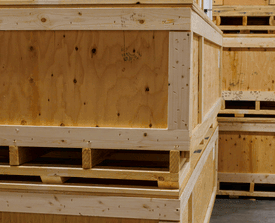
Knight Wall Systems® is dedicated to reducing the environmental impacts of the MFI® system through responsible materials and efficient operations. Our steel, sourced from the United States, contains recycled content and comes coated with ZAM®, a Red List Free material that boosts corrosion resistance and extends product lifespan. We use Red List Free thermoset polymers in our ThermaStop® Isolators, enhancing thermal performance and contributing to better building energy efficiency. We also ensure that all steel waste generated during production is recycled. To minimize emissions, we optimize shipping by maximizing crate capacity and grouping shipments for several projects. These initiatives highlight our commitment to sustainability and continual product improvement.
LCA results
| Life cycle stage | A1 Extraction and upstream processing | A2 Transport to factory | A3 Manufacturing |
|
Information modules:
|
(X) A1 Raw material supply | (X) A2 Transport | (X) A3 Manufacturing |
 |
 |
 |
SM Single Score
Learn about SM Single Score results| Impacts per declared unit | 2.35E-01 mPts | 1.10E-02 mPts | 4.77E-03 mPts |
| Materials or processes contributing >20% to total impacts in each life cycle stage | Energy and materials consumed during steel extraction and processing. | Truck transportation to KWS facility. | Electricity consumed during KWS operations. |
TRACI v2.1 results per declared unit
| Life cycle stage | A1 Extraction and upstream processing | A2 Transport to factory | A3 Manufacturing |
Ecological damage
Human health damage
Additional environmental information
| Impact category | Unit | |||
| Fossil fuel depletion | MJ surplus Mega Joule, lower heating value Fossil fuel depletion is the surplus energy to extract minerals and fossil fuels. |
2.65E+00 | 3.92E-01 | 1.20E-01 |
| Ecotoxicity | CTUe Comparative Toxic Units of Ecotoxicity Ecotoxicity causes negative impacts to ecological receptors and, indirectly, to human receptors through the impacts to the ecosystem. |
6.65E+00 | 1.93E-01 | 6.20E-02 |
References
LCA Background Report
Knight Wall Systems LCA Background Report of Rainscreen cladding support systems, KWS 2025; SimaPro Developer 9.6; Ecoinvent v3.10, Industry data 2.0, and US-EI 2.2 databases; TRACI 2.1.
ISO 14025, “Sustainability in buildings and civil engineering works -- Core rules for environmental product declarations of construction products and services”
ISO 21930:2017, "Sustainability in Building Construction — Environmental Declaration of Building Products" serves as the core PCR along with Sustainable Minds Part A.
SM Part A: LCA calculation rules and report requirements, version 2023
August, 2023. Part A review conducted by the Sustainable Minds TAB, [email protected].
SM Part B: Cladding Support Components and Systems, 2022
Oct 31, 2022. Part B review conducted by the Sustainable Minds TAB, [email protected].
Download PDF SM Transparency Report/ EPD
SM Transparency Reports (TR) are ISO 14025 Type III environmental declarations (EPD) that enable purchasers and users to compare the potential environmental performance of products on a life cycle basis. They are designed to present information transparently to make the limitations of comparability more understandable. Environmental declarations of products that conform to the same PCR and include the same life cycle stages, but are made by different manufacturers, may not sufficiently align to support direct comparisons. They therefore cannot be used as comparative assertions unless the conditions as defined in ISO 14025 Section 6.7.2. ‘Requirements for Comparability’ are satisfied. In order to support comparative assertions, this EPD meets all comparability requirements stated in ISO 14025:2006. However, differences in certain assumptions, data quality, and variability between LCA data sets may still exist. Any EPD comparison must be carried out at the building level per ISO 21930 guidelines, use the same sub-category PCR where applicable, include all relevant information modules, be limited to EPDs applying a functional unit, and be based on equivalent scenarios with respect to the context of construction works. Some LCA impact categories and inventory items are still under development and can have high levels of uncertainty. To promote uniform guidance on the data collection, calculation, and reporting of results, the ACLCA methodology (ACLCA 2019) was used.
 SM Transparency Report (EPD)