

LCA results & interpretation CELLU-SHIELD®
Scope and summary
- Cradle to gate
- Cradle to gate with options
- Cradle to grave
Application
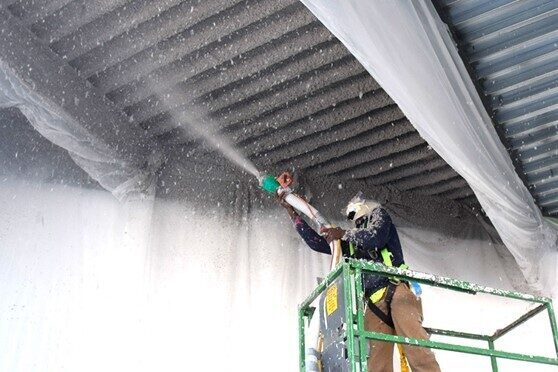
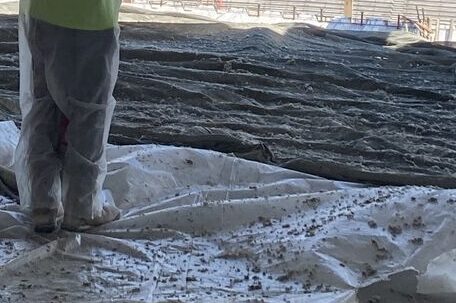
At the installation site, the spray-applied cellulose insulation system is installed using a machine which combines the cellulose material and adhesive/water admix at the nozzle. The spray is directed at the substrate and applied in an even, uninterrupted pattern to meet thermal and acoustical needs.
Functional unit
One square meter of installed insulation material with a thickness that gives an average thermal resistance of RSI = 1m2·K/W with a building service life of 75 years.
Reference service life: 75 years when installed per manufacturer’s instructions
Reference flow: 2.43 kg of cured product, at a thickness of 0.037 m to achieve the functional unit. (ASTM C518)
Default installation, packaging, and disposal scenarios
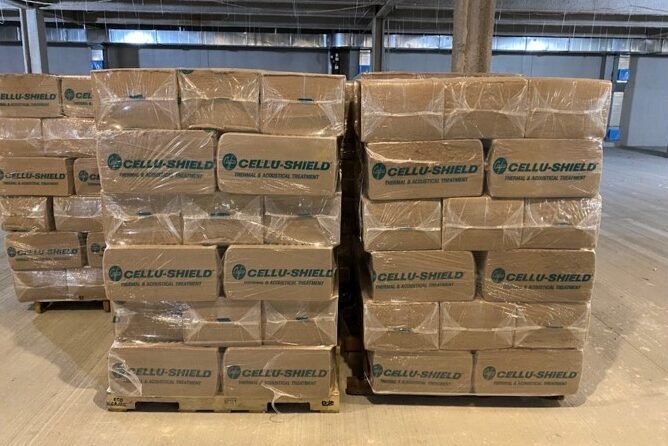
At the installation site, cellulosic material is delivered in 30lb bags and adhesive is delivered in 55gal drums. The installer mixes the adhesive component with water, and the solution is sprayed with the cellulose material onto a surface using an application machine and adhesive pump, which consume 0.09kWh per functional unit. The potential impact of the installation equipment is assumed to be negligible since its use is spread out over hundreds of uses; therefore, it was not included in the model.
During installation, the product is applied assuming a VOC content of ≤500μg/m3, and 5% of the insulation is assumed to be lost to scrap. While some scrap may be reused to fill cracks and crevices depending on the installation site, all scrap was assumed to be landfilled in this study. All packaging waste is assumed to be landfilled, although it would be possible for the 55gal drums to be resused or recycled. No maintenance or replacement is required over the life of the building. After removal, the insulation is assumed to be landfilled. Insulation and packaging waste are assumed to be transported 100km for disposal.
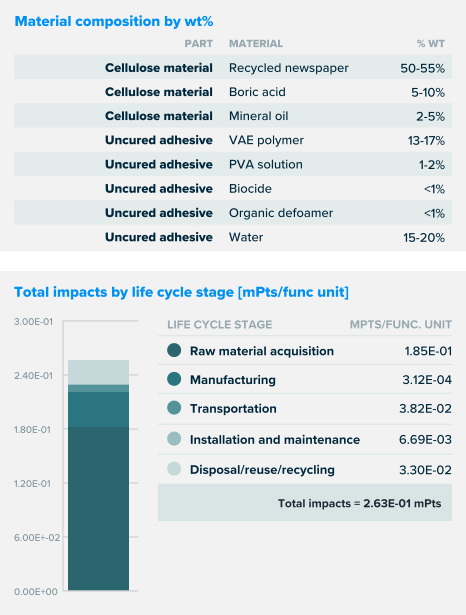
What’s causing the greatest impacts
All life cycle stages
The raw material acquisition stage dominates the results for all impact categories. Among the raw materials, the adhesive component was the largest contributor to total results. The construction and end-of-life phases also notably contribute to total results, due to the use of trucks for outbound transportation, energy and water used during installation, and the landfilling of the insulation and packaging materials.
Raw materials acquisition and transportation
The raw material acquisition stage has the most significant contribution to all impact categories, primarily due to the water-based adhesive. While the cellulose component of the insulation system accounts for a larger share by weight of the raw materials, the use of post-consumer newspaper reduces its contribution to the potential impacts.
Manufacturing stage
The manufacturing stage has the least significant contribution to all impact categories. Activities in this stage include on-site operations, inspection and testing, and final product packaging.
Distribution and installation
The construction stage is the second highest contributor for all impact categories except for global warming and eutrophication. Trucks used for product distribution were the primary contributors in this stage, followed by the energy and water used during installation and the disposal of scrap and packaging.
End of life
The end-of-life impacts are largely due to landfilling of the product after it has been removed from the building and transported to a landfill. Since materials are assumed to be landfilled at the end of life rather than incinerated or reused/recycled, no materials are available for energy recovery or reuse/recycling. The durability of the applied product makes its removal difficult, so it is not expected that recovering the end-of-life product is possible for recycling or energy recovery.
Embodied carbon
Embodied carbon can be defined as the cradle-to-gate (A1-A3) global warming potential impacts. The total embodied carbon per functional unit of applied insulation is 3.22E+00 kg CO2-eq per functional unit.
Manufacturing data
Reporting period: August 2023 – July 2024
Location: Warren, IN
How we're making it greener
Isolatek International is committed to legal compliance and ethical business practices in all of our operations. Isolatek's vendors must act in accordance with the applicable statutory and international standards regarding environmental protection. Isolatek's vendors must minimize environmental pollution and make continuous improvements in environmental protection.
Isolatek's vendors must set up or use a reasonable environmental management system. In Isolatek's purchase arrangements, vendors must observe all applicable laws of their country and international standards, including but not limited to laws and standards relating to the environment, as well as health and safety.
LCA results
| Life cycle stage | Raw material acquisition | Manufacturing | Transportation | Installation and maintenance | Disposal/ reuse/ recycling |
|
Information modules: *Module D is also excluded from this system boundary (MND). |
(X) A1 Raw materials | (X) A3 Manufacturing | (X) A4 Distribution | (X) A5 Installation | (X) C1 Deconstruction |
| (X) A2 Transportation | (X) B1 Use | (X) C2 Transportation | |||
| (X) B2 Maintenance | (X) C3 Waste processing | ||||
| (X) B3 Repair | (X) C4 Disposal | ||||
| (X) B4 Replacement | |||||
| (X) B5 Refurbishment | |||||
| (X) B6 Operational energy use | |||||
| (X) B7 Operational water use | |||||
 |
 |
 |
 |
 |
SM Single Score
Learn about SM Single Score results| Impacts per 1 square meter of insulation material | 1.85E-01 mPts | 3.12E-04 mPts | 3.82E-02 mPts | 6.69E-03 mPts | 3.30E-02 mPts |
| Materials or processes contributing >20% to total impacts in each life cycle stage | Extraction and preprocessing of adhesive component. | Packaging associated with the final product. | Truck transportation used to transport product to building site. | Transportation to landfill and landfilling of packaging materials. | Transportation to landfill and landfilling of product at end of life. |
TRACI v2.1 results per functional unit
| Life cycle stage | Raw material acquisition | Manufacturing | Transportation | Installation and maintenance | Disposal/ reuse/ recycling |
Ecological damage
Human health damage
Additional environmental information
| Impact category | Unit | |||||
| Carcinogenics | CTUh Comparative Toxic Units of Human cancerous toxicity Carcinogens have the potential to form cancers in humans. |
91.7% | 0.02% | 3.3% | 1.3% | 3.7% |
| Non-carcinogenics | CTUh Comparative Toxic Units of Human non-cancerous toxicity Non-Carcinogens have the potential to causes non-cancerous adverse impacts to human health. |
68.4% | 0.01% | 15.6% | 1.8% | 14.2% |
| Ecotoxicity | CTUe Comparative Toxic Units of Ecotoxicity Ecotoxicity causes negative impacts to ecological receptors and, indirectly, to human receptors through the impacts to the ecosystem. |
56.5% | 0.01% | 37.4% | 0.9% | 5.2% |
| Fossil fuel depletion | MJ surplus Mega Joule, lower heating value Fossil fuel depletion is the surplus energy to extract minerals and fossil fuels. |
7.19E+00 | 1.37E-02 | 1.17E+00 | 1.73E-01 | 6.83E-01 |
References
LCA Background Report
LCA of Isolatek International CELLU-SHIELD® (public version), Isolatek 2024. Developed using the TRACI v2.1 and CML impact assessment methodologies, SimaPro Analyst 9.6 modeling software, and ecoinvent v3.10, US-EI 2.2 databases.
ISO 14025, “Sustainability in buildings and civil engineering works -- Core rules for environmental product declarations of construction products and services”
ISO 21930:2017 serves as the core PCR along with UL Part A.
UL Part A: Life Cycle Assessment Calculation Rules and Report Requirements v4.0
March, 2022. PCR review conducted by Lindita Bushi, PhD, Chair (Athena Sustainable Materials Institute), [email protected]; Hugues Imbeault-Tétreault (Group AGECO); and Jack Geibig (Ecoform).
UL Part B: Building Envelope Thermal Insulation EPD Requirements, v3.0
February, 2024. PCR review conducted by Thomas Gloria, PhD, Chair (Industrial Ecology Consultants) [email protected]; Christoph Koffler, PhD (thinkstep); Andre Desjarlais (Oak Ridge National Laboratory).
UL Environment General Program Instructions v2.4, July 2018 (available upon request)
Download PDF SM Transparency Report/ EPD
SM Transparency Reports (TR) are ISO 14025 Type III environmental declarations (EPD) that enable purchasers and users to compare the potential environmental performance of products on a life cycle basis. Environmental declarations from different programs (ISO 14025) may not be comparable. Comparison of the environmental performance of products using EPD information shall be based on the product’s use and impacts at the building level, and therefore EPDs may not be used for comparability purposes when not considering the building energy use phase as instructed under this PCR. Full conformance with the PCR for Building Envelope Thermal Insulation allows EPD comparability only when all stages of a life cycle have been considered. However, variations and deviations are possible. Example of variations: Different LCA software and background LCI datasets may lead to differences results for upstream or downstream of the life cycle stages declared.
 SM Transparency Report (EPD)