

LCA results & interpretation BLAZE-SHIELD® II, II HS & HP
Scope and summary
- Cradle to gate
- Cradle to gate with options
- Cradle to grave
Application
BLAZE-SHIELD® II is industry-leading commercial density Dry Mix Spray-Applied Fire Resistive Material (SFRM). It is Portland cement and mineral wool based applied fireproofing material available in commercial densities, as well as with high bonding capabilities to satisfy the International Building Code (IBC) bond strength requirement for buildings up to 420 ft in height.
Declared unit
1,000 kg of spray-applied fire-resistive material, packaging included.
Manufacturing activities
Products are manufactured by blending the specified bulking agent with a number of product-specific binders to achieve prescribed fire rating performance in the field. Finished goods are packaged in individual bags, stacked on pallets, and stretch wrapped before delivery to job sites.
Manufacturing data
Reporting period: January 2024 – December 2024
Locations: Huntington, IN
Distribution and installation scenarios
The product belongs to the CAFCO 300 SFRM subcategory, as the product density falls within the range of 15–20 pcf (240–320 kg/m³). Distribution from the manufacturing facility to the construction site is assumed to be 500 km (311 miles) using a single unit truck with an empty backhaul. 1.377 m³ of water and 6.3 kWh of electricity is assumed to be consumed during installation.
No gasoline or diesel-powered equipment is assumed to be used during installation. Therefore, the net calorific value (i.e., Lower Heating Value, LHV) of fuels is considered to be zero in A5.
What’s causing the greatest impacts
All life cycle stages
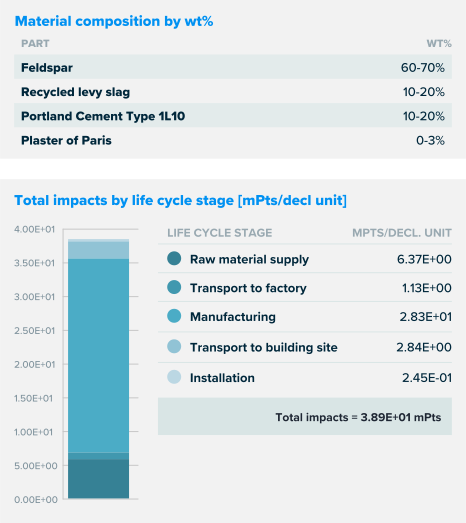
The environmental impacts are primarily driven by the manufacturing phase. The stage dominates across all impact categories except for the non-carcinogens category. Following this, the raw material supply phase is the second-largest contributor across most categories.
The raw material transportation and transport to the building site phases contribute comparable levels of impact. Ultimately, the installation stage results in the lowest overall impacts.
Raw material supply
The raw material supply phase is the second largest contributor to environmental impacts, accounting for roughly 16% of the total global warming potential under both the IPCC AR6 and TRACI 2.2 methodologies. This impact is driven primarily by the use of Portland cement, which is responsible for about 90% of CO₂-equivalent emissions within this phase.
Across most other impact categories, the raw material supply phase also has a considerable influence, contributing 10–30% of total impacts, with the exception of the non-carcinogenics category.
Transport to factory and transport to building site
The transport to factory and transport to building site phases are more strongly linked to the non-carcinogenics category. While these two phases each contribute less than 10% to most other impact categories, their influence on the non-carcinogenics impact category is greater. The transport to factory phase accounts for about 17%, and thetransport to building site phase contributes roughly 43% of total non-carcinogenic impacts. This elevated contribution is primarily driven by the transport of raw materials and finished products, which generates nitrogen oxides (NOₓ) and particulate matter, both of which are known to cause potential non-carcinogenic health effects.
Manufacturing
The manufacturing phase is the most significant contributor, accounting for over 70% of the total global warming potential under both the IPCC AR6 and TRACI 2.2 methodologies. This impact is largely driven by the use of coke-fired furnaces needed to melt recycled slag and rock into mineral wool. The manufacturing stage is also the dominant contributor, accounting for 50–90% of the total impacts in most categories. In the non-carcinogenic category, it ranks as the second-largest contributor, with approximately 30% of the impact attributed to this phase.
Installation
The installation phase has a minimal overall impact. Its contribution to the global warming potential is less than 1%. In the acidification, ecotoxicity, and freshwater eutrophication categories, approximately 1% of the impact originates from phase A5. Across all other impact categories, this phase contributes even less.
Embodied carbon
Embodied carbon can be defined as the cradle-to-gate (A1-A3) IPCCTotal global warming potential impacts. The embodied carbon per declared unit of BLAZE-SHIELD® II is 1.16E+03 kg CO2-eq for Huntington.
How we're making it greener
Isolatek International is committed to legal compliance and ethical business practices in all of our operations. Isolatek's vendors must act in accordance with the applicable statutory and international standards regarding environmental protection. Isolatek's vendors must minimize environmental pollution and make continuous improvements in environmental protection.
Isolatek's vendors must set up or use a reasonable environmental management system. In Isolatek's purchase arrangements, vendors must observe all applicable laws of their country and international standards, including but not limited to laws and standards relating to the environment, as well as health and safety.
LCA results
| Life cycle stage | Raw material supply | Transportation | Manufacturing | Transportation | Installation |
|
Information modules:
|
(X) A1 Raw Material extraction and upstream processing | (X) A2 Transport to factory | (X) A3 Manufacturing | (X) A4 Transport to building site | (X) A5 Installation |
 |
 |
 |
 |
 |
SM Single Score
Learn about SM Single Score results| Impacts per declared unit | 6.37E+00 mPts | 1.13E+00 mPts | 2.83E+01 mPts | 2.84E+00 mPts | 2.45E-01 mPts |
| Materials or processes contributing >20% to total impacts in each life cycle stage | Raw extraction and upstream manufacturing. | Truck and rail transportation used to transport raw materials to manufacturing site. | Energy and ancillary materials required to make the passive fire protection product. | Truck and rail transportation used to transport finished products to construction site. | Energy and water used for installation. |
TRACI v2.2 results per declared unit - BLAZE-SHIELD® II produced in Huntington, IN
| Life cycle stage | A1 Raw material supply | A2 Transport | A3 Manufacturing | A4 Transport to building site | A5 Installation |
Ecological damage
Human health damage
Additional environmental information
| Impact category | Unit | |||||
| Carcinogenics | CTUh Comparative Toxic Units of Human cancerous toxicity Carcinogens have the potential to form cancers in humans. |
1.11E+01 | 1.52E+00 | 2.43E+01 | 3.83E+00 | 1.60E-01 |
| Non-carcinogenics | CTUh Comparative Toxic Units of Human non-cancerous toxicity Non-Carcinogens have the potential to causes non-cancerous adverse impacts to human health. |
2.93E+01 | 5.20E+01 | 9.37E+01 | 1.31E+02 | 2.20E+00 |
| Ecotoxicity | CTUe Comparative Toxic Units of Ecotoxicity Ecotoxicity causes negative impacts to ecological receptors and, indirectly, to human receptors through the impacts to the ecosystem. |
7.31E-02 | 6.69E-03 | 5.75E-01 | 1.68E-02 | 9.17E-03 |
References
LCA Background Report
LCA of Isolatek International Passive Fire Protection Products (public version), Isolatek 2025. Developed using the TRACI v2.2, IPCC 2021 AR6, CML, and Cumulative Energy Demand (LHV) impact assessment methodologies, SimaPro Craft 10.2 software, and ecoinvent v3.11 database.
ISO 14025, “Sustainability in buildings and civil engineering works -- Core rules for environmental product declarations of construction products and services”
ISO 21930:2007, "Sustainability in Building Construction — Environmental Declaration of Building Products" serves as the core PCR.
Smart EPD Part A product category rules for building and construction products and services; Version 1.2, March 2025. PCR review conducted by Jack Geibig (chair, [email protected]); Terrie Boguski; and Hugues Imbeault-Tétreault.
Smart EPD Part B product category rules for Spray-applied Fire-Resistive Materials (SFRM); Version 4.0, January 2025. PCR review conducted by Thomas Gloria, PhD (chair, [email protected]); Karl Houser; and Jack Geibig.
Smart EPD General Program Instructions
Download PDF SM Transparency Report/ EPD
SM Transparency Reports (TR) are ISO 14025 Type III environmental declarations (EPD) that enable purchasers and users to compare the potential environmental performance of products on a life cycle basis. They are designed to present information transparently to make the limitations of comparability more understandable. Environmental declarations of products that conform to the same PCR and include the same life cycle stages, but are made by different manufacturers, may not sufficiently align to support direct comparisons. They therefore cannot be used as comparative assertions unless the conditions as defined in ISO 14025 Section 6.7.2. ‘Requirements for Comparability’ are satisfied. In order to support comparative assertions, this EPD meets all comparability requirements stated in ISO 14025:2006. However, differences in certain assumptions, data quality, and variability between LCA data sets may still exist. Example of variations: Different LCA software and background LCI datasets may lead to differences in results upstream or downstream of the life cycle stages declared. EPDs are only comparable if they conform with ISO 21930, this sub-category PCR, include all relevant information modules and are based on equivalent scenarios with respect to the construction works context. Some LCA impact categories and inventory items are still under development and can have high levels of uncertainty. The science supporting this additional environmental information is still under development and may have high levels of uncertainty that preclude international acceptance pending further development. Use caution when interpreting data in this category. To promote uniform guidance on the data collection, calculation, and reporting of results, the ACLCA methodology (ACLCA 2019) was used. The environmental impact results of products in this document are based on a declared unit and therefore do not provide sufficient information to establish comparisons. The results shall not be used for comparisons without knowledge of how the physical properties of the product impact the precise function at the construction level. The environmental impact results shall be converted to a functional unit basis before any comparison is attempted. A manufacturer shall not make claims based on an industry-average EPD which leads the market to believe the industry-average is representative of manufacturer-specific or product-specific results.
 SM Transparency Report (EPD)