

LCA results & interpretation Marble Facades, Cladding & Walls
Scope and summary
- Cradle to gate
- Cradle to gate with options
- Cradle to grave
Product description
Stone cladding is applied to a building exterior to separate it from the natural environment and provide an outer layer to the building. It not only provides a control to weather elements but also a durable, aesthetically pleasing building appearance. Marble cladding is used in commercial, residential, and public sector buildings.
The results in this study are presented for cladding with a thickness of 48.16mm.
Functional unit
The functional unit is one square meter of installed natural stone cladding for a service life of 75 years. No replacement will be needed during the entire Estimated service life of buildings (ESL). The product system in this study also includes the ancillary materials used in the installation of the product – mortar and masonry connectors. Materials needed to meet functional unit are:
Natural stone - 129.94 kg per m2
Mortar - 4.88 kg per m2
Masonry connectors - 0.62 kg per m2
Water - 1.00 liter per m2
Detailed information for functional unit properties is shown on Page 4.
Manufacturing data
The data for all marble stone products were collected from Polycor's marble quarries and processing facilities covering a period of two years: January 2020 to December 2021. Data for marble quarry operations were collected from two quarry sites across North America and grouped as North American marble quarries.
After marble is extracted from the quarry, it goes to a processing facility. Stone processor operations data were collected from one Polycor marble processing site in North America.
- American Marble Plants: one manufacturing facility in Georgia.
Data were collected from quarries and producers mainly operating in North America (mainly the US). As such, the geographical coverage for this study is based on North American conditions.
Default installation, packaging, and disposal scenarios
Cladding is delivered at the job site ready for installation, where minor cuts may be necessary to accommodate design. The amount of ancillary materials used depend largely on the building design, but most stone cladding installations incorporate anchors and mortar, used either as masonry bed or to fill veneer cavities. Wood and cardboard used as packaging to safely deliver the stone to the site is then transported to be either landfilled or recycled, following US EPA's end of life scenarios for containers and packaging. At the end of its useful life, the cladding is removed and transported to be either landfilled (31.5%) or recycled (68.5%).
Other life cycle stages
Cement mortar used during the installation (A5) of marble cladding also generates significant environmental impacts in the overall life cycle impacts of marble cladding. Under normal operating conditions, marble cladding will not require any cleaning. Due to the nature of natural stone, it is anticipated that the stone cladding products will last for the lifetime of the building. The reference service life (RSL) thus meets an ESL of 75 years, and cladding will need no replacements during its service life. The use stage is not relevant since stone cladding does not require any repair, replacement, or refurbishment during its entire service life. End-of-life stages have lower contributions to the total life cycle impacts.
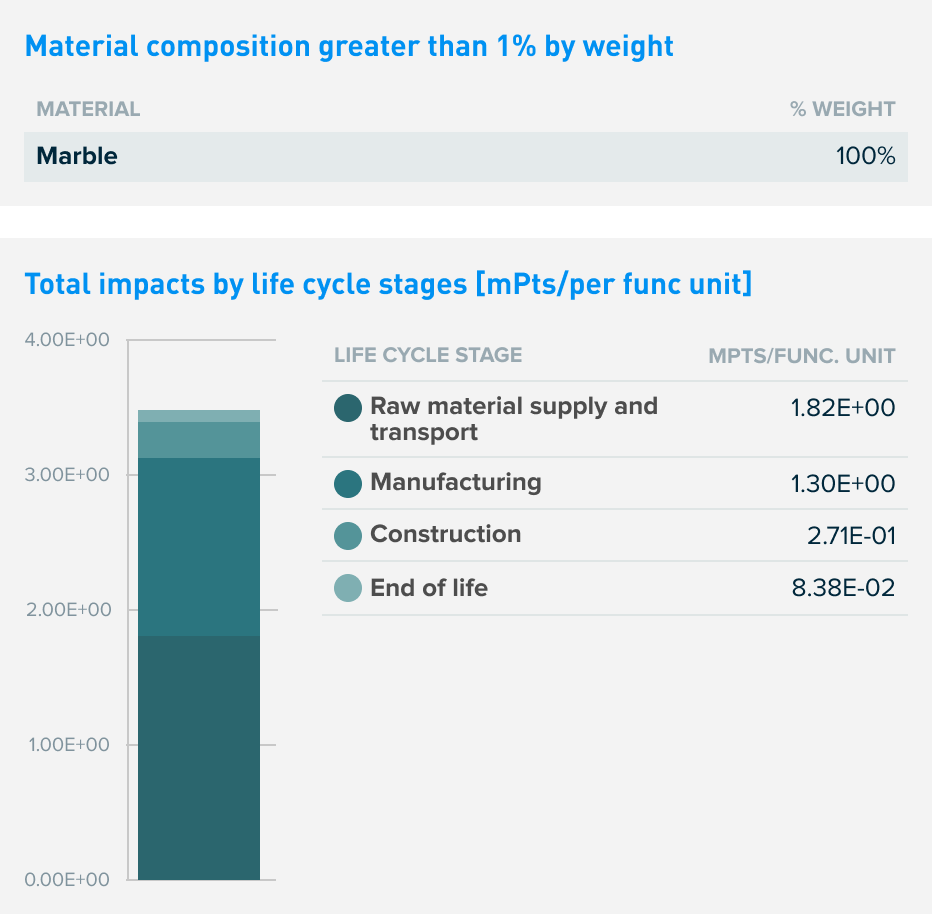
What’s causing the greatest impacts
All life cycle stages
For the natural stone cladding product, the cradle-to-gate stage (A1-A3) dominates the results for all impact categories. This study assessed a multitude of inventory and environmental indicators. In addition to the six major impact categories (global warming potential, ozone depletion, acidification, smog, eutrophication, and fossil fuel depletion), additional impact categories have also been included. These six impact categories are globally deemed mature enough to be included in Type III environmental declarations. Other categories are being developed and defined, and LCA should continue making advances in their development. However, the EPD users shall not use additional measures for comparative purposes. LCIA results are relative expressions and do not predict impacts on category endpoints, the exceeding of thresholds, safety margins or risks.
Overall results are consistent with expectations for stone cladding's life cycles, with most of the impacts being generated during cradle-to-gate stages, as cladding is not associated with energy consumption during its use stage.
The primary finding, across the environmental indicators, was that cradle-to-gate stage (A1-A3) dominates the impacts due to the energy consumed at the quarries and processing plants. The quarry operations (A1) stage is the highest contributor to most of the impact categories, followed by the processor operations (A3). The cradle-to-gate stage (A1-A3) contributes to ~80% of the total impacts in all impact categories. The transportation of stone from quarries to processing plants, transportation of cladding from processing plants to the installation sites, and use of mortar during installation also generate significant impacts in the overall life cycle impacts of marble cladding.
Quarry operations and transport to processors
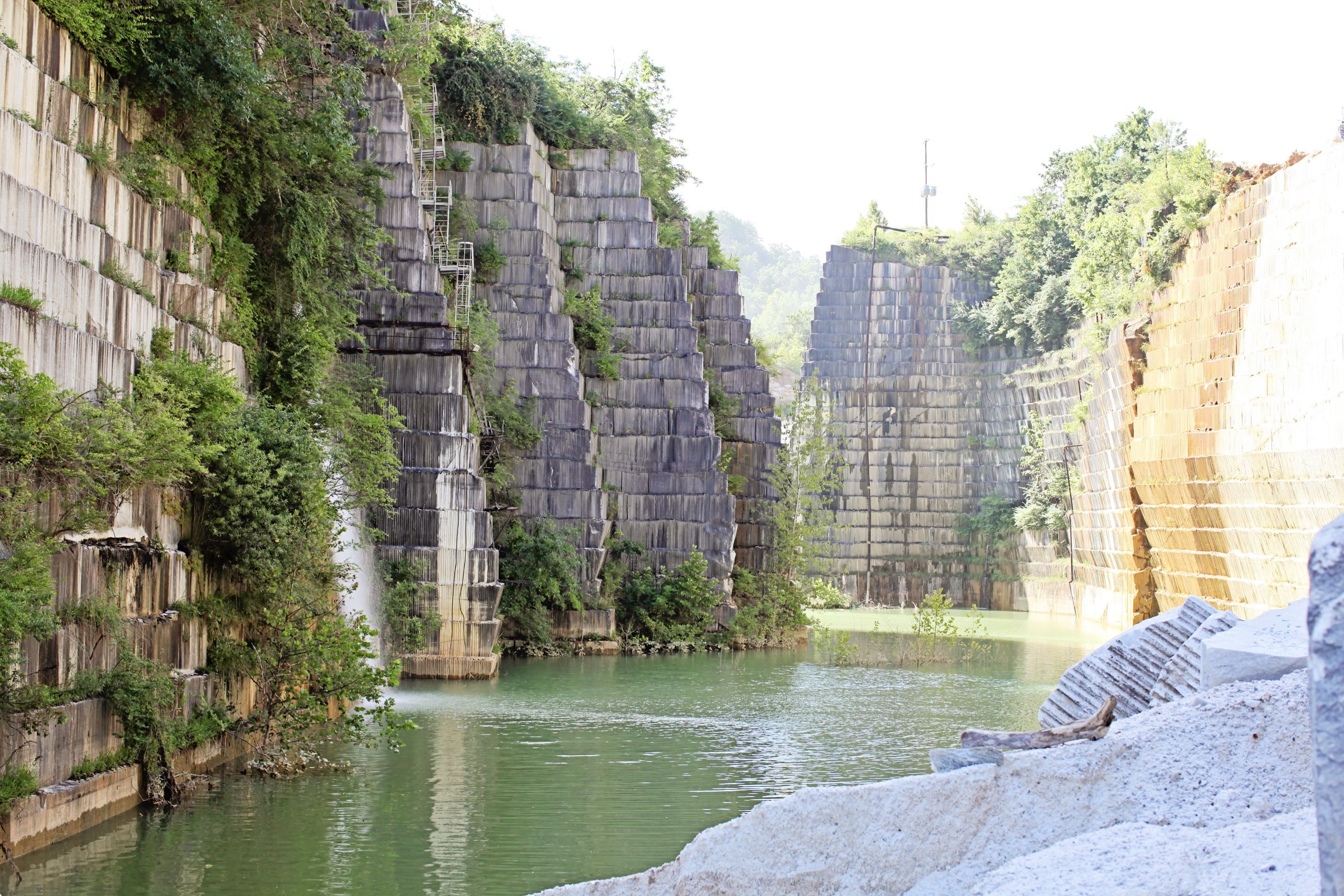
Quarry operations (A1) stage is the highest contributor to most of the impact categories. The impacts generated are mainly because of the use of grid electricity and fuels in the quarries. Other material inputs generate little impact in comparison to the electricity and fuel consumed. The transportation of stone from quarries to processing plants also generates significant impacts in numerous impact categories.
Processor operations and transport to building sites
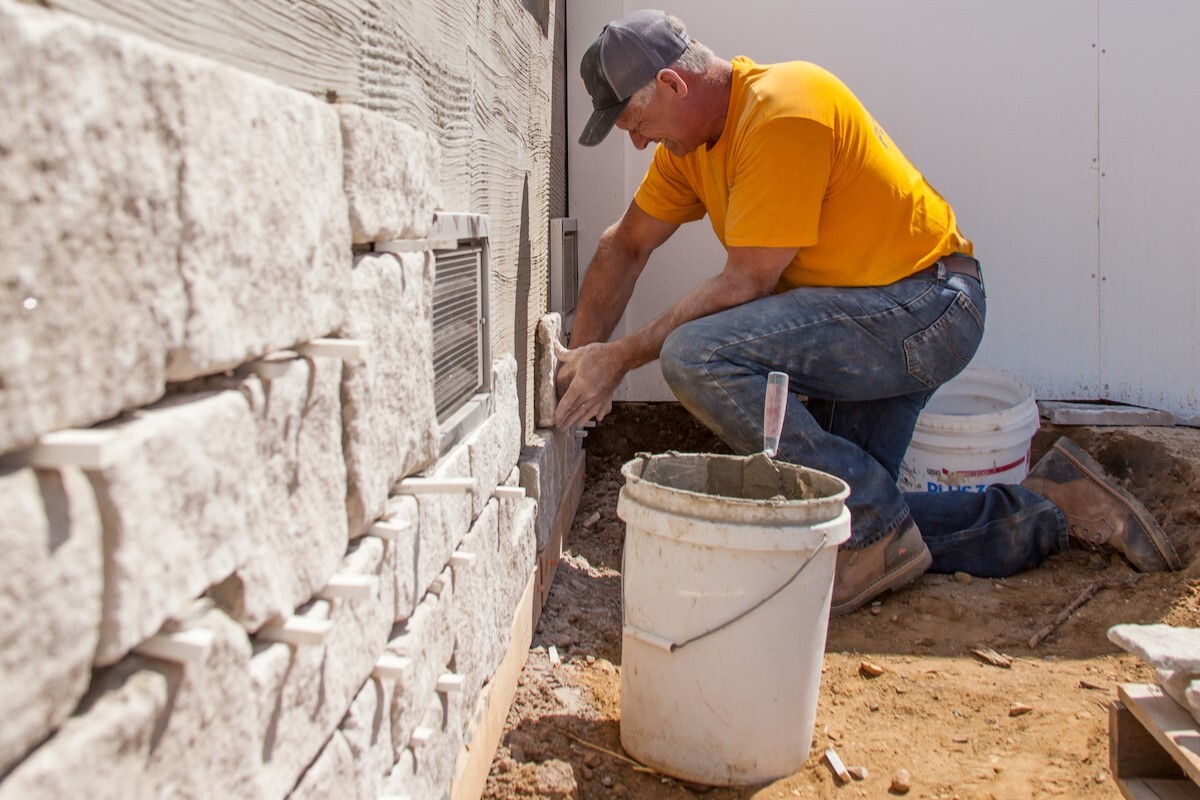
Manufacturing operations at processing plants (A3) is also a great impact contributor. It makes up the greatest share of four out of ten impact categories. Energy consumed at processors (both electricity and fuels) is responsible for the majority of impacts, while other material inputs have an insignificant contribution. The transportation of stone cladding manufactured in processor plants to the building sites also makes a significant impact on the overall life cycle impacts of natural stone cladding.
Sensitivity analysis
Based on the recommendation provided by Polycor, impacts for processor operations specific to a square meter of marble cladding was assumed to match the average stone processing for square meter of marble. A sensitivity analysis was performed to check the robustness of the results when the energy consumed during processing is varied by +/-20% from the estimate used in this study. The resulting variation in total life cycle impacts of marble cladding is ~9% for potential CO2 equivalent emissions and ~8% for fossil fuel depletion. Other impact categories also follow a similar trend.
How we're making it greener
Natural stone is one of the lowest embodied carbon construction materials. Although we are proud of this intrinsic quality, we want to make sure that we'll never stop improving it. Our main driver is our ambitious 2025 carbon neutrality pledge. By increasing the use of renewable energy, reducing our dependency on fossil fuels, electrifying our car fleet and increasing the energy efficiency throughout our value chain, we aim to reduce our embodied carbon by 40% by the end of 2025!
Beyond embodied carbon, Polycor only uses rainwater for stone extraction, recycles it, and also uses dry sawing technology in a growing number of quarry operations. In quarrying, production, installation and maintenance, natural stone lowers water use throughout its life cycle.
Polycor is the leader within the Natural Stone Sustainability Standard (ANSI 373) with 25% of our sites certified. This standard examines and verifies numerous areas of natural stone production, effectively improving the baseline for the environmental and social performance of natural stone in alignment with green building practices.
LCA results
| Life cycle stage | Raw material Supply and transport | Manufacturing | Construction | Use | End of life |
|
Information modules: Included (X) | Excluded* (MND) |
A1 Quarry operations | A3 Processor operations | A4 Stone transport to building sites | B1 Use | C1 Deconstruction |
| A2 Transport to processors | A5 Installation | B2 Maintenance | C2 Waste Transport | ||
| B3 Repair | C3 Waste processing | ||||
| B4 Replacement | C4 Disposal | ||||
| B5 Refurbishment | |||||
| B6 Operational energy use | |||||
| B7 Operational water use | |||||
 |
 |
 |
 |
SM Single Score
Learn about SM Single Score results| Impacts of 1 square meter of installed natural stone cladding | 1.82E+00 mPts | 1.30E+00 mPts | 2.71E-01 mPts | 0 mPts | 8.38E-02 mPts |
| Materials or processes contributing >20% to total impacts in each life cycle stage | Energy consumed during stone quarrying (electricity and fuels). | Energy consumed during stone processing (electricity and fuels). | Truck transportation and use of ancillary materials (mainly mortar) for installation.. | NA | Waste transport to end of life centers. |
TRACI v2.1 results per functional unit
| Life cycle stage | A1-A2 Quarry operations and transport |
A3 Processor operations |
A4-A5 Stone transport to building sites |
B1-B7 Use |
C1-C4 End-of-life |
Ecological damage
Human health damage
Additional environmental information
| Impact category | Unit | |||||
| Fossil fuel depletion | MJ surplus Mega Joule, lower heating value Fossil fuel depletion is the surplus energy to extract minerals and fossil fuels. |
3.99E+01 | 3.75E+01 | 7.03E+00 | 0 | 4.00E+00 |
| Ecotoxicity | CTUe Comparative Toxic Units of Ecotoxicity Ecotoxicity causes negative impacts to ecological receptors and, indirectly, to human receptors through the impacts to the ecosystem. |
73.3 % | 19.9 % | 4.5 % | 0 % | 2.3 % |
References
LCA Background Report
Polycor Natural Stone Cladding LCA Background Report (public version), Polycor 2023. SimaPro Analyst 9.4, ecoinvent 3.4 database.
ISO 21930:2017 serves as the core PCR along UL Part A.
ULE PCR Part A: Life Cycle Assessment Calculation Rules and Report Requirements v3.2
December, 2018. Technical Advisory Panel members reviewed and provided feedback on content written by UL Environment and USGBC. Past and present members of the Technical Advisory Panel are listed in the PCR.
ULE PCR Part B: Cladding Product Systems EPD requirements v2.0
April 2021. PCR review conducted by: Jim Mellentine (Thrive ESG); Christopher White (NIST), Ph.D.; and Philip S. Moser, P.E.(MA) (Simpson Gumpertz & Heger).
UL Environment General Program Instructions v2.5, March 2021 (available upon request)
ISO 14025, “Sustainability in buildings and civil engineering works -- Core rules for environmental product declarations of construction products and services”
Download PDF SM Transparency Report, which includes the additional EPD content required by the UL Environment PCR.
SM Transparency Reports (TR) are ISO 14025 Type III environmental declarations (EPD) that enable purchasers and users to compare the potential environmental performance of products on a life cycle basis. Environmental declarations from different programs (ISO 14025) may not be comparable. Comparison of the environmental performance of Cladding Product Systems using EPD information shall be based on the product’s use and impacts at the building level, and therefore EPDs may not be used for comparability purposes when not considering the building energy use phase. Full conformance with the PCR for stone cladding allows EPD comparability only when all stages of a life cycle have been considered, when they comply with all referenced standards, use the same sub-category PCR, and use equivalent scenarios with respect to construction works. However, variations and deviations are possible.
Example of variations: Different LCA software and background LCI datasets may lead to differences results for upstream or downstream of the life cycle stages declared
 SM Transparency Report (EPD)