

How we make it greener EcoBatt® and EcoRoll® Insulation
Utilize recycled content
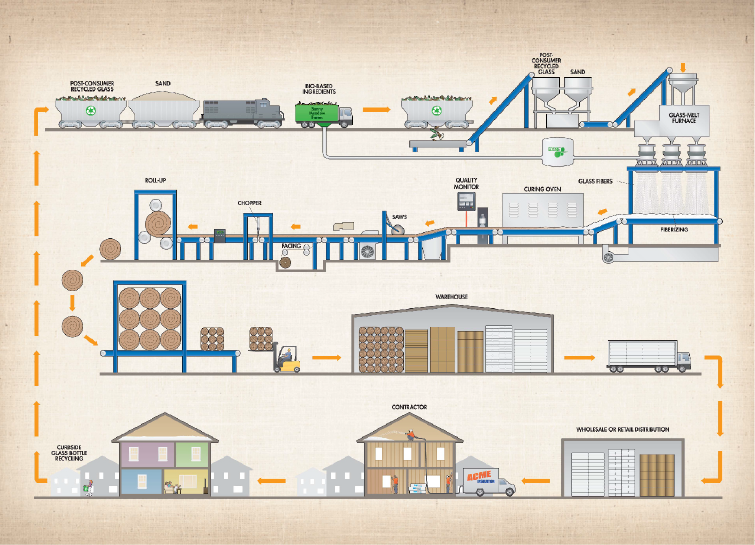
By leveraging recycled content, we reduce the energy required to form glass fibers.
- We use about 10 railcars of recycled glass per day.

Lead green chemistry efforts
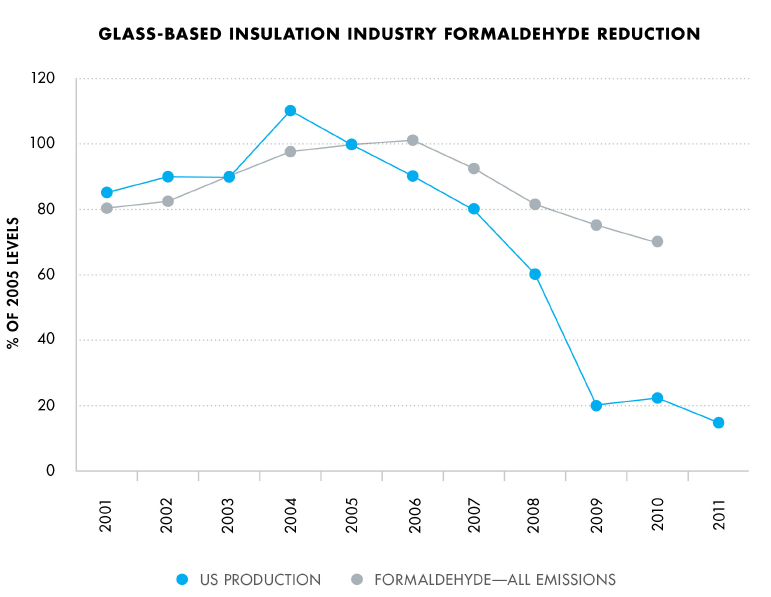
Following the launch of our ECOSE® Technology in 2008, we had transformed most of our products and processes to this new technology. Using our bio-based ECOSE® Technology has removed phenol and formaldehyde from our stack emissions. This initiative not only established Knauf Insulation North America in a leadership position, but it had a transformative impact on our industry in general.

Reduce scrap generation and energy consumption
Continuous improvement is the methodology we utilize to engage the entire Knauf team in our manufacturing excellence and sustainability journey.
Knauf Insulation, comprised of Knauf Insulation North America (KINA) and Knauf Insulation Europe, Middle East, Asia, Asia Pacific (KI EMEA & APAC), share an overall global certification for ISO 45001 Health & Safety, ISO 14001 Environmental, ISO 50001 Energy, and ISO 9001 Quality through a third-party Certification Body.
Our Continuous Improvement Program, with all its tools and systems associated with it, provide a formal process where we are constantly monitoring our manufacturing and sustainability Key Performance Indicators (KPIs) with an eye towards improvement. This Continuous Improvement centric management system has proven to be effective in improving our sustainability by reducing scrap generation and energy consumption.
Green manufacturing Processes
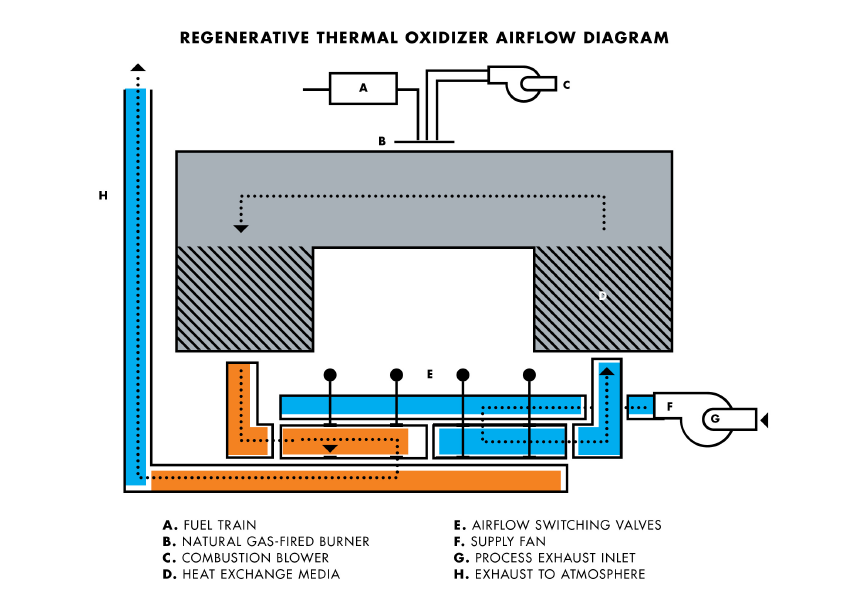
Regenerative thermal oxidizers We use regenerative thermal oxidizers (RTO) to capture and recycle much of the energy we use to cure our products. RTO is equipment used for the treatment of exhaust air. Our ovens exhaust into a ceramic heat exchange media to capture and reuse the heat in the exhausted air. Therefore, the amount of energy required to cure our product is reduced substantially.

Leverage compression packaging
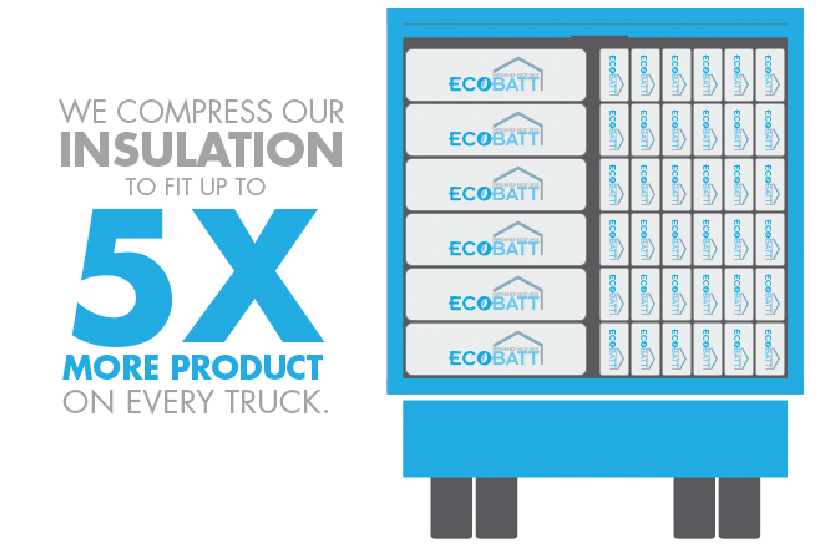
Glass is a high modulus material, which helps to facilitate compression packaging. We compress our insulation to fit up to five times more product on every truck, thereby reducing the amount of deliveries that need to be made, which saves time and emissions from transportation.
Be confident in glass fiber's safety
In the past, a label regarding the carcinogenic potential of insulation made from glass fibers was required on all packaging. Following forty years of research, fiberglass has been exonerated entirely. Our fiberglass is comprised of fibers that are biosoluble, meaning that the fibers dissolve in the body in a short period of time and exit the body with normal bodily functions. The scrutiny fiberglass has undergone is now seen as proof of its safety.
Meet and exceed green standards
GREENGUARD certified On the forefront of indoor air quality, Knauf Insulation North America had the first GREENGUARD certified product in 2002. This achievement led us to understand the impact our formaldehyde-free products could have on the indoor environment. The formaldehyde-free claim is third party validated by UL Environment.
3rd Party UL Environmental Claim Validation states that Knauf Insulation products manufactured in North America contain an average of 61% recycled content, consisting of 20% post-consumer and 41% pre-consumer recycled glass.
EUCEB tested Glass fiber is a widely studied building material. All of our processes and formulations are voluntarily third-party audited for compliance with the health and safety exoneration criteria for glass and rock based fiber through the European Certification Board for Mineral Wool Products (EUCEB) exoneration process. This guarantees the formulations are biosoluble and pose no health concerns. Having over 35 years of research behind its safety, fiberglass products have been thoroughly evaluated and therefore we believe it is one of the safest building materials available today.

Green building rating systems
Our products offer a vast array of potential credits for major green building rating systems, including: WELL, LEED v4, International Green Construction Code, Green Guide for Heath Care, NAHB Green Building Standard, and more.
Visit the green building rating systems page to see all the credits you can earn using Manson and Knauf Insulation products
Promote Recycling
By taking a comprehensive approach of the benefits of recycling, Knauf Insulation North America advocates and promotes local recycling initiatives as well as actively participates in state and local government policy development. In addition, as a member of the North American Insulation Manufacturers Association (NAIMA) and Glass Recycling Coalition (GRC), we encourage regulatory and legislative initiatives that focus on glass recycling infrastructure deployment to increase the availability of post-consumer recycled glass.
 SM Transparency Report (EPD) ™ + Material Health Overview ™
- VERIFICATION LCA
- 3rd-party verified
- Transparency Report (EPD)
- 3rd-party verified
Validity: 12/12/23 – 12/12/28
KNA – 12122023 – 001
- Material HealthMaterial
evaluation - Self-declared
This environmental product declaration (EPD) was externally verified by Harmony Environmental, LLC, according to ISO 21930:2017; UL Part A; UL Part B for Building Envelope Thermal Insulation Products; and ISO 14025:2006.
Harmony Environmental, LLC
16362 W. Briarwood Ct.
Olathe, KS 66062
www.harmonyenviro.com
(913) 780-3328

SUMMARY
Reference PCR
UL Part B: Building Envelope Thermal Insulation v2.0
Regions; system boundaries
North America; Cradle-to-grave
Functional unit / ESL:
1 m2 installed insulation material, packaging included, with thickness that gives average thermal resistance of RSI = 1m2·K/W over an estimated service life (ESL) of 75 years
LCIA methodology: TRACI 2.1
LCA software; LCI database
LCA for Experts v10.7; LCA for Experts 2023
In accordance with ISO 14044 and the reference PCR, this life cycle assessment was conducted by Sustainable Minds and verified by Harmony Environmental, LLC.
Public LCA:
Knauf Insulation North America and Manson Insulation Products
©2026 | The SM Transparency Report™ Program is operated by Sustainable Minds® | Privacy policy
Knauf Insulation, Inc.
One Knauf Drive
Shelbyville, IN 46176
www.knaufinsulation.us
317 398 4434
Insulation glossary
| Amount | Total amount of either square footage (SF) or lineal footage (LF) required to complete the project |
| ASJ+ - all service jacket | Aluminum foil, reinforced with a glass scrim bonded to a kraft paper interleaving with an outer film layer leaving no paper exposed. |
| BTU (British Thermal Unit) | Heat required to raise temperature of one pound of water by one degree; around the same amount of energy released by one wooden match. |
| Cavity depth | Depth of either wood or metal framing components used to determine the amount of insulation that can be installed within a given cavity. |
| Class I vapor retarder | 0.1 perm or less |
| Class II vapor retarder | 1.0 perm or less |
| Class III vapor retarder | 10 perm or less |
| Closed blow | A netted application of loosefill insulation where the net holds the insulation in place during installation and remains in place for the life of the system |
| C-value | Heat flow property, conductance, of a product at a given thickness. The lower the C, the better the insulator. |
| Density | Amount of solid material, expressed in pounds per cubic foot (PCF). |
| Emittance | Used for measuring the resistance of a material to radiative heat transfer. Typical values are 0.02 - 1, with the lower values being better radiant barriers. |
| Facer | Covering adhered to base glass mineral wool material. Used primarily as a vapor retarder, and secondarily for cleanability, color, or integral structural components. |
| FSK- foil scrim kraft | Laminate composed of thin layer of aluminum foil, glass fiber reinforcing scrim, and kraft paper. |
| Installed R-value (Duct wrap) | Laminate composed of thin layer of aluminum foil, glass fiber reinforcing scrim, and kraft paper. |
| K-value | Heat flow thickness of a homogeneous material. The lower the k, the better the insulator. |
| Open blow | Loosefill insulation with integral adhesive, directly applied to the wall cavity without need for additional netting |
| Perm | Unit of permeance of water vapor transmission where a difference in pressure exists on either side of a material or membrane (US perm = 1 grain of water vapor per hour, per square foot, per inch of mercury). |
| Pipe size | Pipe sizes are expressed in imperial units for either iron pipe (Iron Pipe Size - IPS) or copper tube size (CTS) |
| PSK- poly scrim kraft | String reinforced polyethylene kraft facing. |
| R-value | Ability of material, or building section to retard heat flow. The higher the R, the better the insulator. |
| U-value | Heat flow property of an entire building section. The lower the U, the better the insulating value. |
| Vapor retarder | Thin layer of material varying in permeance, included in building construction to slow moisture migration. Vapor retarders are split into three classes. |