

EPD additional content Commercial Wall-Mount Lavatory
Data
Background This product-specific plant-specific declaration was created by collecting production data from the Mexico location. All unit processes were modeled using primary data. Secondary data sources include those available in ecoinvent and USLCI databases. Literature data was used to fill any data gaps to complete the inventory. In the manufacturing of the products, secondary materials such as scrap metals and metal bars used to hold the primary products in place were partially incorporated in the manufacturing of the primary products but were not considered due to a lack of background data in the LCA model.
Cut-off criteria for the inclusion of mass and energy flows are 1% of renewable primary resource (energy) usage, 1% nonrenewable primary resource (energy) usage, 1% of the total mass input of that unit process, and 1% of environmental impacts. The total of neglected input flows per module does not exceed 5% of energy usage, mass, and environmental impacts. The only exceptions to these criteria are substances with hazardous and toxic properties, which must be listed even when the given process unit is under the cut-off criterion of 1% of the total mass.
The commercial lavatory products have no materials considered hazardous or toxic according to the TRI or local regulations. Non-ceramic parts that are included with the lavatories are the wall bracket and mounting screws. All parts with a weight of >1% weight of the parts (excluding ceramic and packaging materials) are included in the LCA model. A check has been performed to make sure that the completeness of the overall material use is >99.0wt% of the finished product after cut-off, including the ceramic and packaging materials.
Data sets contributing 5% or more to any environmental impact category
| Data set name | Database name and version | Software type and version | Geography | Allocation method |
| Stainless steel, SUS303 (austenitic) 9% Ni 18% Cr US-EI China | ecoinvent v3.10 | SimaPro Analyst 9.6 | China | By mass |
| Corrugated board, fresh fibre, double wall, at plant/RER U US-EI 2.2 | US-EI 2.2 | SimaPro Analyst 9.6 | United States | By mass |
| Electricity, low voltage, at grid, Mexico US-EI 2.2 | US-EI 2.2 | SimaPro Analyst 9.6 | Mexico | By mass |
| Heat, natural gas, at boiler modulating <100kW/RER S | ecoinvent v3.10 | SimaPro Analyst 9.6 | Europe | By mass |
| Transport, combination truck, average fuel mix NREL/US U | USLCI | SimaPro Analyst 9.6 | United States | By mass |
| Transport, lorry >16t, fleet average/RER S | ecoinvent v3.10 | SimaPro Analyst 9.6 | Europe | By mass |
Flow diagram
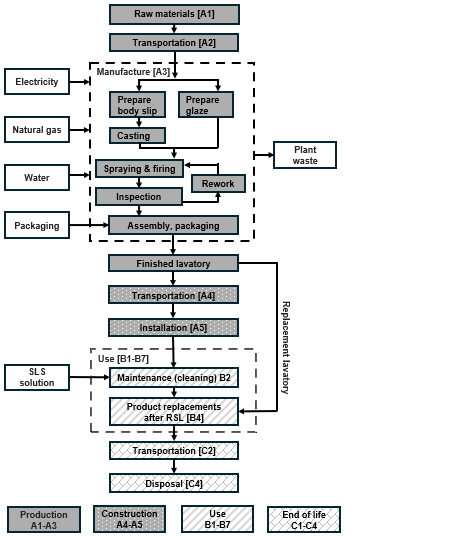
Scenarios and additional technical information
Distribution [A4]
| Plant location | Fairburn, GA |
| Distance (TOTO Mexico to plant) | 3,277 km |
| Vehicle type | Diesel truck |
In 2023, outbound shipments of lavatories from Fairburn were transported an average of 883 miles (1,421 km) by diesel truck and an average of 1,269 miles (2,042 km) by rail. The quantity transported by truck is 83%, and by rail 17%.
End of life [C1-C4]
The model reflects the assumptions that lavatories are 100% disposed in a sanitary landfill. The product is assumed to be transported 100 km via truck to final disposal.
However, it should be noted that many of the associated metal and plastic components follow the waste scenarios as listed in the table below. TOTO ceramic materials can be recycled as aggregate in several applications, although this is not currently common practice. Secondary materials, including shredded and sorted metal waste, are valuable goods that lose their status as waste after the sorting process. No additional waste processing is needed in that case, and no credits for material recovery are given.
| Material | Potential waste scenario - Recycling | Potential waste scenario - Landfill |
| Stainless steel | 70.50% | 29.50% |
| Ceramic | 0.00% | 100% |
| Corrugated board, paper | 66.50% | 33.50% |
| Pallet | 14.50% | 85.50% |
Product information
| Product code | ASTM or ANSI product specification | Physical properties and technical information |
| LT307R(A) | ASME A112.19.2/CSA B45.1 Certifications: IAPMO(cUPC) | Commercial lavatory |
Allocation Allocations of multi-input and multi-output processes follow a mass-based approach in the collected data, which is the most appropriate for the unit processes modeled. Allocation approaches in the background data follow the ecoinvent methodology. No co-product allocations were made in the model.
Major system boundary exclusions
- Construction of major capital equipment, water & wastewater infrastructure
- Maintenance and operation of support equipment
- Human labor and employee transport
- Manufacture & transport of packaging materials not associated w/ final product
- Energy consumption in warehouses, distribution centers, and retail facilities during the course of transport to the final customer
- Disposal of packaging materials not associated with final product
- Building operational energy and water use
Major assumptions and limitations
- Transportation of all raw materials with the mass above 1% of the cumulative mass of the model, products from vendors, is estimated based on rail lines and port information.
- Pallet use is assumed based on the average numbers per unit of product and reported pallet quantity of specific models.
Data quality assessment
Precision: The precision of the data is considered high. Product engineers provided detailed bills of materials, and facility managers provided utility information for the manufacturing facilities. The raw material transportation distances were calculated based on the raw material manufacturers’ addresses, extracted from the relevant SDSs.
Proxy datasets were utilized in the LCA model when secondary data were not available, as shown in Appendix A in the published LCA background report.
Completeness: The data included is considered complete. The LCA model included all known material and energy flows. As pointed out in that section, no known flows above 1% were excluded and the sum of all excluded flows totals less than 5%, whether evaluated by mass, energy, or potential environmental impact.
Consistency: The consistency of the model is considered high. The bills of materials provided by the product engineers were developed for multiple internal departments use and are maintained regularly.
The LCA practitioner also cross-referenced the installation documents and other relevant information to ensure consistency. Furthermore, modeling assumptions were consistent across the model, with preference given towards SimaPro data, where available.
The reported values for all indicators in the below table for B1, B3, and B5-C1 are zero.
LCIA results, resource use, output and waste flows, and carbon emissions & removals per functional unit
| Parameter | A1-A3 | A4 | A5 | B2 | B4 | C2 | C3 | C4 | Total |
| LCIA results | |||||||||
| Smog (kg O3 eq) | 2.35E+00 | 8.90E-01 | 1.98E-03 | 3.76E-01 | 1.62E+01 | 4.09E-02 | 0.00E+00 | 3.19E-02 | 1.99E+01 |
| Ozone depletion (kg CFC-11 eq) | 5.72E-06 | 5.92E-09 | 2.67E-09 | 4.95E-07 | 3.27E-05 | 4.52E-10 | 0.00E+00 | 5.87E-08 | 3.90E-05 |
| Eutrophication (kg N eq) | 1.66E-02 | 1.96E-03 | 1.13E-03 | 4.83E-03 | 1.07E-01 | 9.24E-05 | 0.00E+00 | 1.14E-04 | 1.32E-01 |
| Acidification (kg SO2 eq) | 1.34E-01 | 3.22E-02 | 1.75E-04 | 4.33E-02 | 9.23E-01 | 1.42E-03 | 0.00E+00 | 1.12E-03 | 1.14E+00 |
| Respiratory effects (kg PM2.5 eq) | 1.41E-02 | 6.92E-04 | 1.42E-05 | 3.73E-03 | 8.41E-02 | 2.22E-05 | 0.00E+00 | 1.18E-04 | 1.03E-01 |
| Global warming (kg CO2 eq) | 4.24E+01 | 5.28E+00 | 7.32E-01 | 7.79E+00 | 2.69E+02 | 2.57E-01 | 0.00E+00 | 1.54E-01 | 3.25E+02 |
| Additional environmental information | |||||||||
| Fossil fuel depletion (MJ surplus) | 8.48E+01 | 9.15E+00 | 3.01E-02 | 2.27E+01 | 5.52E+02 | 4.54E-01 | 0.00E+00 | 5.35E-01 | 6.69E+02 |
| Ecotoxicity (CTUe) | 3.85E+01 | 1.29E+01 | 1.77E-02 | 3.82E+00 | 2.48E+02 | 6.32E-01 | 0.00E+00 | 5.79E-02 | 3.04E+02 |
| Carcinogenics (CTUh) | 1.60E-06 | 7.25E-08 | 3.41E-10 | 1.59E-07 | 8.42E-06 | 3.55E-09 | 0.00E+00 | 1.58E-09 | 1.03E-05 |
| Non carcinogenics (CTUh) | 4.27E-06 | 6.90E-07 | 3.47E-09 | 1.56E-06 | 2.81E-05 | 3.31E-08 | 0.00E+00 | 8.30E-09 | 3.47E-05 |
| Resource use indicators | |||||||||
| Renewable primary energy used as energy carrier (fuel) (MJ, LHV) | -9.06E+01 | -3.02E+01 | -3.04E+01 | -1.52E+01 | -3.47E+02 | -2.99E+01 | 0.00E+00 | -3.04E+01 | -5.74E+02 |
| Renewable primary resources with energy content used as material (MJ, LHV) | 1.57E+02 | 3.04E+01 | 3.04E+01 | 3.04E+01 | 6.08E+02 | 2.99E+01 | 0.00E+00 | 3.04E+01 | 9.13E+02 |
| Total use of renewable primary resources with energy content (MJ, LHV) | 6.60E+01 | 2.04E-01 | 9.46E-03 | 1.53E+01 | 2.61E+02 | 7.44E-03 | 0.00E+00 | 2.73E-02 | 3.43E+02 |
| Non-renewable primary resources used as an energy carrier (fuel) (MJ, LHV) | 7.30E+02 | 7.00E+01 | 2.41E-01 | 2.03E+02 | 4.73E+03 | 3.42E+00 | 0.00E+00 | 4.09E+00 | 5.74E+03 |
| Non-renewable primary resources with energy content used as material (MJ, LHV) | 2.18E-01 | 4.24E-02 | 4.24E-02 | 4.24E-02 | 6.46E-01 | 4.24E-02 | 0.00E+00 | 4.24E-02 | 1.08E+00 |
| Total use of non-renewable primary resources with energy content (MJ, LHV) | 7.30E+02 | 7.00E+01 | 2.84E-01 | 2.03E+02 | 4.73E+03 | 3.46E+00 | 0.00E+00 | 4.14E+00 | 5.74E+03 |
| Secondary materials (kg) | 0 | 0 | 0 | 0.00E+00 | 0.00E+00 | 0.00E+00 | 0.00E+00 | 0.00E+00 | 0.00E+00 |
| Renewable secondary fuels (MJ, LHV) | 0 | 0 | 0 | 0.00E+00 | 0.00E+00 | 0.00E+00 | 0.00E+00 | 0.00E+00 | 0.00E+00 |
| Non-renewable secondary fuels (MJ, LHV) | 0 | 0 | 0 | 0.00E+00 | 0.00E+00 | 0.00E+00 | 0.00E+00 | 0.00E+00 | 0.00E+00 |
| Recovered energy (MJ, LHV) | 0 | 0 | 0 | 0.00E+00 | 0.00E+00 | 0.00E+00 | 0.00E+00 | 0.00E+00 | 0.00E+00 |
| Use of net fresh water resources (m3) | 1.10E-02 | 7.80E-04 | 1.06E-02 | 1.57E-04 | 4.08E-04 | 3.02E-04 | 0.00E+00 | 9.95E-04 | 2.42E-02 |
| Abiotic depletion potential, fossil (MJ) | 6.30E+02 | 6.55E+01 | 2.34E-01 | 1.75E+02 | 4.10E+03 | 3.21E+00 | 0.00E+00 | 3.80E+00 | 4.98E+03 |
| Output flows and waste category indicators | |||||||||
| Hazardous waste disposed (kg) | 2.70E-01 | 0 | 0 | 0 | 0 | 0 | 0 | 0 | 2.70E-01 |
| Non-hazardous waste disposed (kg) | 4.70E-01 | 1.20E+00 | 1.43E+00 | 2.93E+01 | 7.74E+01 | 5.40E-01 | 0.00E+00 | 1.87E+01 | 1.30E+02 |
| High-level radioactive waste, conditioned, to final repository (kg) | 3.09E-01 | 1.30E-05 | 4.78E-07 | 7.64E-04 | 2.61E-01 | 6.72E-07 | 0.00E+00 | 2.16E-06 | 5.71E-01 |
| Intermediate- and low-level radioactive waste, conditioned, to final repository (kg) | 5.69E-05 | 6.66E-08 | 4.31E-09 | 1.72E-06 | 4.75E-05 | 6.43E-09 | 0.00E+00 | 1.06E-08 | 1.06E-04 |
| Components for re-use (kg) | 0 | 0 | 0 | 0 | 0 | 0 | 0 | 0 | 0 |
| Materials for recycling (kg) | 0 | 0 | 0 | 2.93E+01 | 5.33E+01 | 2.09E+00 | 0.00E+00 | 2.09E+00 | 8.67E+01 |
| Materials for energy recovery (kg) | 0 | 0 | 0 | 0 | 0 | 0 | 0 | 0 | 0 |
| Exported energy (MJ, LHV) | 0 | 0 | 0 | 0 | 0 | 0 | 0 | 0 | 0 |
| Carbon emissions and removals | |||||||||
| Biogenic Carbon Removal from Product (kg CO2) | 0 | 0 | 0 | 0 | 0 | 0 | 0 | 0 | 0 |
| Biogenic Carbon Emission from Product (kg CO2) | 0 | 0 | 0 | 0.00E+00 | 0.00E+00 | 0 | 0 | 0 | 0 |
| Biogenic Carbon Removal from Packaging (kg CO2) | 1.74E+00 | 0 | 0 | 0.00E+00 | 4.79E+00 | 0 | 0 | 0 | 6.53E+00 |
| Biogenic Carbon Emission from Packaging (kg CO2) | 0 | 0 | 1.74E+00 | 0.00E+00 | 4.79E+00 | 0 | 0 | 0 | 6.53E+00 |
| Biogenic Carbon Emission from Combustion of Waste from Renewable Sources Used in Production Processes (kg CO2) | 0 | 0 | 0 | 0 | 0 | 0 | 0 | 0 | 0 |
| Calcination Carbon Emissions (kg CO2) | 0 | 0 | 0 | 0.00E+00 | 0.00E+00 | 0 | 0 | 0 | 0 |
| Carbonation Carbon Removals (kg CO2) | 0 | 0 | 0 | 0 | 0 | 0 | 0 | 0 | 0 |
| Carbon Emissions from Combustion of Waste from Renewable and Non-Renewable Sources used in Production Processes (kg CO2) | 0 | 0 | 0 | 0 | 0 | 0 | 0 | 0 | 0 |
 SM Transparency Report (EPD)