LCA results & interpretation Pyrocrete Series
Scope and summary
- Cradle to gate
- Cradle to gate with options
- Cradle to grave
Product description
Carboline’s Pyrocrete products are Portland cement-based, cementitious fireproofing that is mixed with clean, potable water onsite before application. The products are spray applied to the substrate using either piston or rotor stator or squeeze type pumps. Pyrocrete products provide fire protection for structural steel and can also be used to upgrade the fire resistance of existing concrete. They are high density cementitious fireproofing products designed for the fire protection of exterior and interior structural steel.
Carboline’s Pyrocrete series includes four products: Pyrocrete 239, Pyrocrete 241, Pyrocrete 341, and Pyrocrete 40. The impacts are presented for these four products covered in this report. The kraft paper bag packaging weight for these products as delivered are 1.66 kg, 1.54 kg, 0.56kg, and 1.66 kg, respectively.
Declared unit
The declared unit is 1,000 kg of product. The results in this report are expressed in terms of potential impacts per 1,000 kg of product from cradle to gate.
Manufacturing data
Time coverage: The data covers annual manufacturing data for the 2021 calendar year from Carboline’s manufacturing plant in Lake Charles, Louisiana. This period of time was chosen in order to capture a representative picture of businesses activities at Carboline.
Geographical coverage: The geographical coverage for this study is based on United States system boundaries for all processes and products.
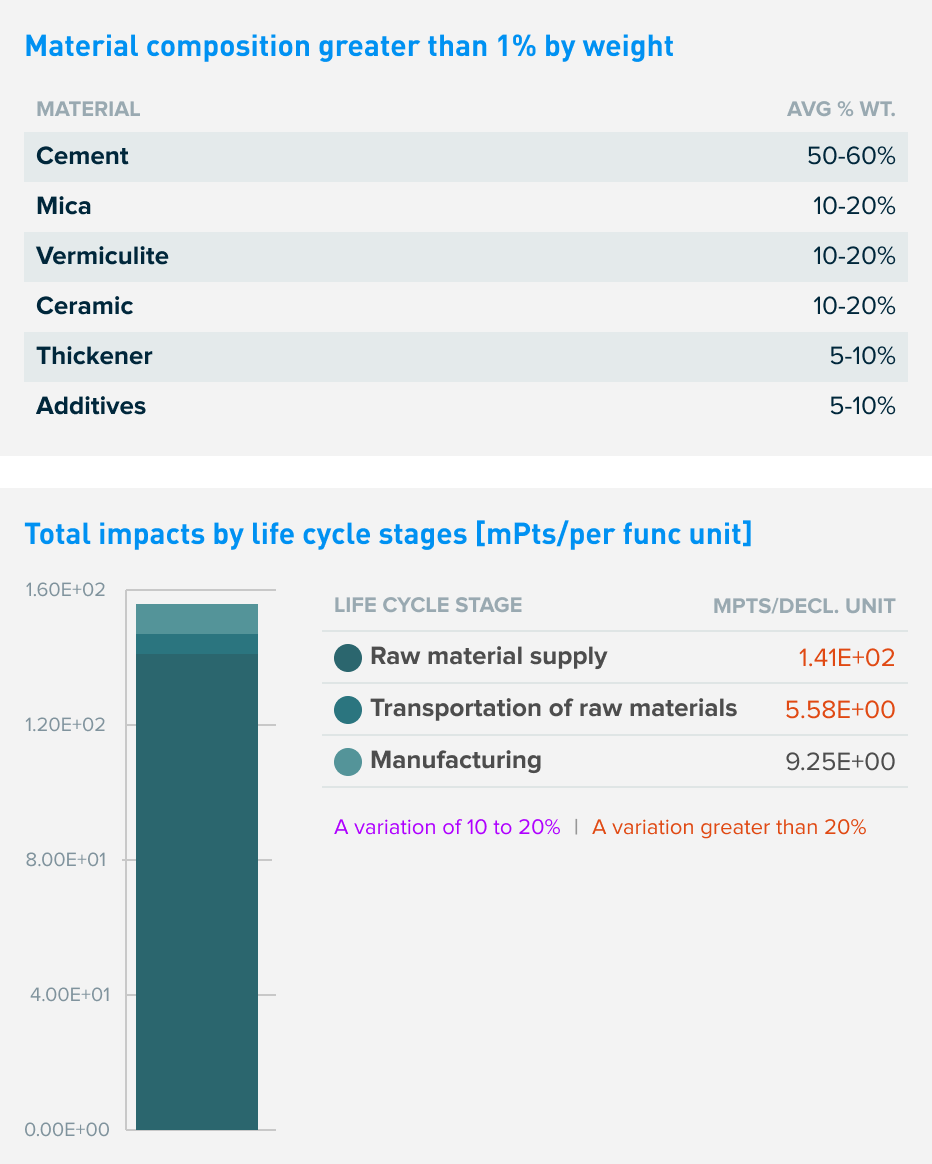
What’s causing the greatest impacts
All life cycle stages
Activities during the supply of raw materials (A1) are responsible for much of the impacts in each impact category. The next highest impact contributor is manufacturing (A3) in most of the impact categories.
Raw material supply
Raw material supply (A1) includes raw material extraction and upstream processing. This module dominates the results for most of the impact categories. For example, A1 accounts for over 65% of the impact of global warming, smog, and acidification. It also contributes to over 50% of ozone depletion and eutrophication.
Transportation
Average transportation distances and modes of transport are included for the transportation of raw materials to the production facility. Typical vehicles used include trucks and ships. Transportation of raw materials is a relatively small contributor to all product life cycle impacts.
Manufacturing
Manufacturing (A3) is the second highest contributor to eight impact categories for Pyrocrete 239, seven impact categories for Pyrocrete 241, five impact categories for Pyrocrete 341, and six impact categories for Pyrocrete 40.
System boundary
The figure below illustrates the system boundary for the LCA, defining which life cycle stages are included and which are excluded. For this report, the system boundary is cradle-to-gate, which includes modules A1, A2, and A3: raw materials extraction, processing, transportation, and manufacturing/final assembly for both the product and its associated packaging. All other life cycle stages are excluded from the analysis.

Sensitivity analysis
Sensitivity analyses were performed to check the robustness of the results where the highest potential environmental impacts are occurring. As the bulk of impacts are attributed to raw materials acquisition and processing, the mass of specified raw materials was changed by +/-20%. These raw materials were chosen based on a combination of relatively higher contribution to the results.
Global warming potential was evaluated for sensitivity since Carboline is interested in the potential CO2-equivalent emissions of its products. The range of change in total life cycle impacts was in a +/-6-12% change.
How we're making it greener
Carboline is committed to finding new and efficient alternatives in manufacturing, raw material sourcing, and logistics to improve sustainability efforts. One of Carboline’s most impactful contributions is the creation of the SLOB Program (slow moving and obsolete inventory). To reduce hazardous waste generation, the SLOB Program was designed to provide optics to Carboline’s Inventory Analytics Team to review inventory close to expiration. Preventative measures are taken to rework inventory or sell this material at a discounted rate, with the ultimate goal of preventing little to zero waste of unused material. As an RPM company, Carboline is dedicated to working towards reaching the goals that have been set through RPM’s Building a Better World Program. These goals include reducing energy consumption, landfill contributions, and water reuse/conservation opportunities.
LCA results
| Life cycle stage | Production stage | Production stage | Production stage |
|
Information modules: Included (X) |
|
A1 Raw material supply | A2 Transport | A3 Manufacturing |
 |
 |
 |
SM Single Score
Learn about SM Single Score results| Impacts per 1,000kg of coating | 1.41E+02 mPts | 5.58E+00 mPts | 9.25E+00 mPts |
| Materials or processes contributing >20% to total impacts in each life cycle stage | Energy used for raw material extraction (electricity and fuels). | Truck and trailer transportation (fuel consumption). | Energy and electricity consumed for coating production. |
Pyrocrete 239: TRACI v2.1 results per declared unit
| Life cycle stage | A1 Raw material supply | A2 Transport | A3 Manufacturing |
Ecological damage
Human health damage
Additional environmental information
| Impact category | Unit | |||
| Fossil fuel depletion | MJ surplus Mega Joule, lower heating value Fossil fuel depletion is the surplus energy to extract minerals and fossil fuels. |
3.38E+02 | 1.13E+02 | 2.44E+02 |
| Ecotoxicity | CTUe Comparative Toxic Units of Ecotoxicity Ecotoxicity causes negative impacts to ecological receptors and, indirectly, to human receptors through the impacts to the ecosystem. |
4.10E+02 | 1.51E+02 | 2.14E+02 |
Pyrocrete 241: TRACI v2.1 results per declared unit
| Life cycle stage | A1 Raw material supply | A2 Transport | A3 Manufacturing |
Ecological damage
Human health damage
Additional environmental information
| Impact category | Unit | |||
| Fossil fuel depletion | MJ surplus Mega Joule, lower heating value Fossil fuel depletion is the surplus energy to extract minerals and fossil fuels. |
3.39E+02 | 1.69E+02 | 2.41E+02 |
| Ecotoxicity | CTUe Comparative Toxic Units of Ecotoxicity Ecotoxicity causes negative impacts to ecological receptors and, indirectly, to human receptors through the impacts to the ecosystem. |
1.12E+03 | 2.26E+02 | 2.05E+02 |
Pyrocrete 341: TRACI v2.1 results per declared unit
| Life cycle stage | A1 Raw material supply | A2 Transport | A3 Manufacturing |
Ecological damage
Human health damage
Additional environmental information
| Impact category | Unit | |||
| Fossil fuel depletion | MJ surplus Mega Joule, lower heating value Fossil fuel depletion is the surplus energy to extract minerals and fossil fuels. |
1.31E+03 | 2.53E+02 | 2.13E+02 |
| Ecotoxicity | CTUe Comparative Toxic Units of Ecotoxicity Ecotoxicity causes negative impacts to ecological receptors and, indirectly, to human receptors through the impacts to the ecosystem. |
1.16E+03 | 3.38E+02 | 9.94E+01 |
Pyrocrete 40: TRACI v2.1 results per declared unit
| Life cycle stage | A1 Raw material supply | A2 Transport | A3 Manufacturing |
Ecological damage
Human health damage
Additional environmental information
| Impact category | Unit | |||
| Fossil fuel depletion | MJ surplus Mega Joule, lower heating value Fossil fuel depletion is the surplus energy to extract minerals and fossil fuels. |
4.79E+02 | 1.92E+02 | 2.44E+02 |
| Ecotoxicity | CTUe Comparative Toxic Units of Ecotoxicity Ecotoxicity causes negative impacts to ecological receptors and, indirectly, to human receptors through the impacts to the ecosystem. |
7.01E+02 | 2.57E+02 | 2.19E+02 |
References
LCA Background Report
Carboline Spray-Applied Fire-Resistive Materials LCA Background Report (public version), Carboline 2022; SimaPro Analyst 9.4; Ecoinvent 3.4 and US ecoinvent (US-EI 2.2) database; TRACI 2.1
PCR for Spray-applied Fire-Resistive Materials (SFRM)
Valid through Feb. 29, 2023. PCR review conducted by Thomas P. Gloria (Industrial Ecology Consultants), Ph. D; Jeffrey E. Gould (FM Approvals); Karl D. Houser, (Intertek Building and Construction).
ISO 14025, “Sustainability in buildings and civil engineering works -- Core rules for environmental product declarations of construction products and services”
Download PDF SM Transparency Report, which includes the additional EPD content required by the ASTM PCR.
SM Transparency Reports (TR) are ISO 14025 Type III environmental declarations (EPD) that enable purchasers and users to compare the potential environmental performance of products on a life cycle basis. Environmental declarations from different programs (using different PCR) may not be comparable. In order to support comparative assertions, this EPD meets all comparability requirements stated in ISO 14025:2006. However, differences in certain assumptions, data quality, and variability between LCA data sets may still exist. As such, caution should be exercised when evaluating EPDs from different manufacturers, as the EPD results may not be entirely comparable. Any EPD comparison must be carried out at the building level per ISO 21930 guidelines. The results of this EPD reflect an average performance by the product and its actual impacts may vary on a case-to-case basis.
 SM Transparency Report (EPD)